
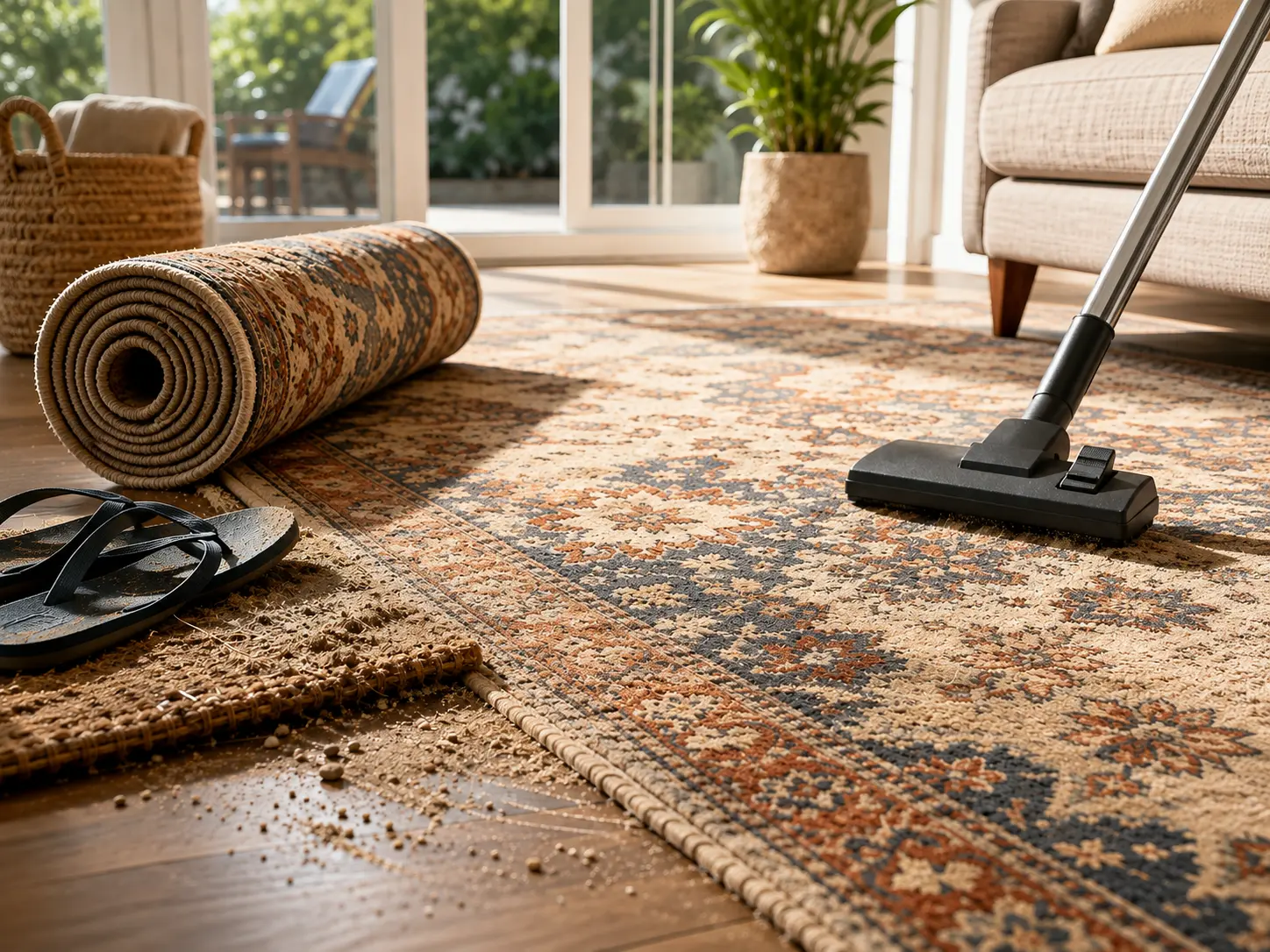
Pull back the furniture at the end of summer and take a close look at the area rug underneath. What you’ll find tells the story of the season: compacted pile in the pathways, a gritty texture underfoot from sand and tracked-in soil, colors that look slightly duller than they did in May, and possibly a spot or two from summer spills that seemed minor at the time.
Summer is the season that accumulates in area rugs fastest. The combination of barefoot traffic, sand and outdoor soil, summer food and drink spills, pet shedding at its annual peak, and the sustained heat and humidity of a Philadelphia-area July and August creates conditions that accelerate every form of rug contamination simultaneously.
In our 45+ years serving Bucks County, Montgomery County, and the wider Philadelphia area, we assess the condition of area rugs after summer more often than any other season. The damage is almost always more significant than homeowners expect when they look closely — and almost always more reversible than they fear. Here’s what summer actually does to area rugs, and what it takes to address it properly before fall.
What You’ll Learn
- The specific damage that sand, sun exposure, and summer foot traffic cause to area rug fibers
- Why end-of-summer is the most important rug care moment of the year
- How to conduct an honest post-summer condition assessment of your rugs
- What you can address at home and what requires professional cleaning
- How Cahill’s free area rug pickup and delivery works for Philadelphia-area homeowners
- Frequently asked questions from Bucks County and Montgomery County rug owners
What Summer Does to Your Area Rugs
Area rugs in active family homes absorb more damage in summer than in any other season — not from any single incident, but from the compounding effect of everything summer brings through the door and across the floor simultaneously.
End-of-summer signs worth assessing in your rugs:
- Flat, compacted pile in the pathways where barefoot traffic was concentrated all summer — fibers that no longer stand upright the way they did before the season
- A gritty, slightly rough texture underfoot particularly near entry points from the backyard or deck, indicating sand and soil compaction below the pile surface
- Colors that appear slightly muted or faded compared to a less-trafficked area of the same rug — often most visible under furniture that wasn’t moved
- One or more spot stains from summer incidents: popsicle drips, fruit juice, sunscreen, pet accidents, or outdoor food brought in from backyard entertaining
- A faint but persistent odor when walking across the rug, particularly in high-pet or high-traffic areas, that’s present even after vacuuming
- Frayed or slightly fuzzy fiber tips in the most heavily trafficked sections — a sign that abrasive soil has been grinding against the fibers from below
Two or more of these present is normal for an area rug that’s been through an active summer in a Bucks County or Montgomery County household. They’re not signs of a damaged rug — they’re signs of a rug that needs professional care before the accumulation compounds further into fall.
What Sand, Sun, and Summer Traffic Actually Do: The Real Causes
Each element of summer creates a distinct type of damage in area rug fibers. Understanding the specific mechanism helps explain why a professional end-of-summer cleaning is more than maintenance — it’s damage prevention that pays forward into fall.
1. Sand: The Internal Abrasive
Sand particles are among the most abrasive materials that can enter a rug’s fiber structure. Their irregular, sharp edges grind against fiber walls with every step, cutting into the structural integrity of the fiber over time. What begins as surface-level grit — visible and somewhat removable by vacuuming — works progressively deeper into the pile with foot traffic, eventually reaching the rug backing where it becomes an abrasive layer beneath the entire fiber column.
For area rugs in homes near the Jersey Shore or lake properties in Bucks County — or simply homes where kids spend time at pools, sprinklers, and sandboxes through the summer — sand accumulation in area rugs can be substantial by August. The damage at the fiber base is invisible from the surface but shows progressively as pile that appears flat, dull, and resistant to recovery even after deep vacuuming.
Professional rug cleaning removes sub-surface sand through a combination of dry soil extraction before wet cleaning — a step that is critical and that most home cleaning attempts skip entirely. Introducing water to a rug still loaded with dry sand grinds the abrasive deeper during the wet process rather than removing it.
2. Summer Foot Traffic: Compaction and Fiber Stress
Area rugs in active households absorb significantly more foot traffic in summer than any other season. Kids home all day, barefoot or in flip-flops, moving constantly across living room and family room rugs; guests coming through for cookouts and gatherings; pets with increased indoor-outdoor movement. The combined foot traffic of three summer months is concentrated on the same pile fiber columns, day after day.
The result is compaction — fibers that have been repeatedly compressed and haven’t had adequate recovery time between uses. Over the course of a summer, compacted fibers begin to lay flat rather than standing upright, creating the flattened traffic lane appearance that makes a rug look worn. This is distinct from fiber damage: the fibers themselves may be structurally intact, but the compaction prevents them from displaying their pile height.
Professional cleaning includes pile grooming after the wet cleaning process, which helps compacted fibers stand upright again and restores the rug’s visible pile height — often dramatically improving how the rug looks even before colors are fully restored.
3. Sun Exposure: Color Degradation in UV-Exposed Rugs
Area rugs placed near windows, sliding glass doors, or in sun-lit rooms are subject to ultraviolet light exposure that gradually degrades dye molecules in the fiber. Summer’s longer days and higher sun angles accelerate this process compared to winter. The result is fading that appears most pronounced in the portions of the rug closest to the light source — creating uneven color that becomes more visible when furniture is moved or when a recently cleaned area is compared to a sun-affected one.
UV fading is not reversible through cleaning, but professional cleaning can restore clarity and vibrancy to the unaffected portions of the rug, making the contrast between faded and unfaded areas less pronounced by returning the overall rug to its cleanest possible baseline. For significant UV fading, rotating the rug periodically prevents uneven exposure from developing further.
4. Humidity and Summer Spills: Biological and Chemical Contamination
The sustained heat and humidity of a Philadelphia-area summer creates conditions in area rug fibers and backing that accelerate biological activity — the same mechanism that produces musty carpet odor also affects rugs sitting on hardwood or tile floors with limited air circulation beneath them. Summer spills — popsicles, fruit juice, sunscreen, pet accidents — add chemical and biological contamination that summer humidity allows to develop more rapidly than it would in cooler, drier months.
Rugs over hardwood are particularly vulnerable: moisture from spills or humidity that wicks through the rug backing can damage the hardwood underneath if it isn’t fully extracted. This is one of the most important reasons professional rug cleaning — which controls moisture carefully and dries the rug in a facility environment rather than in place — is preferable to in-home wet cleaning for area rugs.
The End-of-Summer Rug Assessment: How to Read What You’re Seeing
Before deciding on next steps, run through this practical assessment of each area rug in your home:
- The beat test: take the rug outside and beat it firmly with your palm or a broom handle. The volume of dust and debris that releases tells you how much sub-surface dry soil — including sand — has accumulated below the vacuum’s reach. Significant visible dust cloud means professional cleaning is warranted.
- The fold test: fold a corner of the rug backward and look at the base of the fibers near the backing. Darker, grayer coloration at the fiber roots compared to the pile tips indicates compacted soil that vacuuming hasn’t reached.
- The compression test: press your palm firmly into the center of a traffic area and hold for 10 seconds, then lift quickly. If the pile doesn’t spring back noticeably, compaction from summer traffic is significant.
- The UV comparison: move a piece of furniture that has shielded part of the rug from direct light all summer and compare the colors of the exposed and shielded portions. Color difference indicates UV exposure that will continue to develop if the rug isn’t rotated or cleaned.
- The sniff test: press your face close to the rug surface in the most trafficked area and note any odor. A musty, stale, or ammonia-adjacent smell indicates biological contamination in the fiber base or backing that vacuuming and surface deodorizers cannot resolve.
Two or more of these tests indicating significant accumulation is a clear signal for professional cleaning. One indicator that’s mild can be monitored; one that’s significant — particularly the beat test producing a visible dust cloud or the sniff test revealing strong odor — should be addressed before fall traffic and closed-window conditions allow it to worsen.
End-of-Summer Rug Care: What to Do and How
Home Care Steps That Help
For rugs with mild accumulation, or as maintenance between professional cleanings, these steps make a meaningful difference:
- Take the rug outside and beat it thoroughly — two or three passes with a broom handle or a rug beater to dislodge compacted dry soil and sand before vacuuming
- Vacuum both sides of the rug: vacuuming the underside first dislodges soil from the backing into the pile, where the second pass of the top surface can extract it more effectively
- Use slow, cross-directional vacuum passes on the pile surface — vacuuming in multiple directions lifts compacted pile and extracts more embedded particulate than single-direction passes
- For pet hair embedded in the pile, a rubber-bristle brush or a barely damp sponge dragged across the surface in short strokes lifts hair that vacuum suction doesn’t capture
- Rotate the rug 180 degrees to redistribute traffic patterns and equalize any UV exposure that has developed over the summer
- For minor summer spills that were treated at the time but left a residue shadow, blot with a clean white cloth dampened with cold water — do not over-wet, and do not use soap-based cleaners that leave sticky residue
What Professional Cleaning Accomplishes for End-of-Summer Rugs
Cahill’s professional area rug cleaning is performed at our facility — not in your home — which allows the controlled conditions and professional-grade equipment that in-home cleaning cannot replicate. The process is specifically sequenced to address post-summer accumulation:
- Dry soil extraction before any wet cleaning: compressed air and professional dusting equipment remove sand, particulate, and dry soil from the fiber base before water is introduced — the critical step that prevents wet cleaning from grinding abrasives deeper
- Full-immersion hot water extraction (for appropriate rug types): reaches the fiber base and backing, flushing biological contamination and spill residue that home cleaning leaves behind
- Fiber-type-specific treatment: wool, silk, cotton, and synthetic rugs each require different water temperatures, pH levels, and cleaning agents — our IICRC-certified technicians assess fiber type before any cleaning begins
- Controlled drying in a facility environment: prevents mold and mildew from developing in the backing during drying, eliminates the risk of moisture damage to hardwood floors beneath the rug
- Pile grooming after drying: compacted fibers are groomed back to their natural direction, restoring pile height and the appearance of a rug that looks new again
Cahill’s Free Pickup and Delivery: The Logistical Problem Solved
The reason many Philadelphia-area homeowners delay professional area rug cleaning isn’t the cost or the quality — it’s the logistics. Rolling up a large area rug, getting it into a vehicle, and transporting it to a cleaning facility is a project that keeps getting postponed.
Cahill’s free pickup and delivery eliminates that friction entirely. We come to your home at a scheduled time, pick up the rug, clean it at our facility using the appropriate method for your specific rug’s fiber type and construction, and return it within the week. No transport, no logistics, no rolled-up rug in the back of your SUV.
As one of our customers who had her area rug picked up and returned after a summer with two dogs put it: “They came the next day, picked it up, and it was returned the following week. The rug looks brand new and I have two dogs.” That’s the end-of-summer outcome that professional facility cleaning with free pickup and delivery makes possible.
Why Philadelphia-Area Homeowners Choose Cahill’s for End-of-Summer Rug Care
Area rugs represent a significant investment — in quality, in the aesthetic they create in a room, and in the years of use they should provide. End-of-summer professional cleaning is the single most impactful maintenance decision a rug owner makes annually, because it removes the accumulated damage of the season before it becomes progressive fiber degradation that can’t be reversed.
- 45+ years serving families throughout Philadelphia, Bucks County, and Montgomery County — including assessment and cleaning of every rug type from machine-made synthetic to hand-knotted wool and silk
- IICRC-certified technicians averaging 11 years experience — who inspect fiber type and construction before any cleaning method is selected
- Free pickup and delivery throughout Bucks County, Montgomery County, and Philadelphia — the logistical barrier to professional rug care, eliminated
- Facility cleaning with controlled drying — no moisture damage risk to hardwood floors, no mildew risk from improper in-home wet cleaning
- Free estimates for most rugs over the phone at (215) 355-5388
- 2023 Community’s Choice Award Winner in Bucks and Montgomery Counties
- Nextdoor Neighborhood Favorite, multiple years recognized
- 5-star ratings on Google, Yelp, Angi, and Nextdoor | BBB A+ rated since 2011
Frequently Asked Questions
How do I know if my area rug needs professional cleaning after summer?
Take the rug outside and beat it: if a significant dust cloud releases, the rug has more sub-surface soil than vacuuming is removing. Also fold a corner and examine the fiber base — dark coloration at the roots indicates compacted soil. Persistent odor after vacuuming, visible spot stains, and flat compacted pile in traffic areas all indicate a rug that needs professional attention. If the rug hasn’t been professionally cleaned in 12+ months, schedule regardless of visible symptoms.
How much does area rug cleaning cost in the Philadelphia area?
Cost varies based on rug size, fiber type, construction, and the level of contamination. Cahill’s provides free estimates for most rugs over the phone at (215) 355-5388. Professional cleaning is typically a fraction of the replacement cost of a quality rug and extends life significantly by removing the abrasive dry soil and biological contamination that degrades fibers progressively if left unchecked.
How does Cahill’s free area rug pickup and delivery work?
Call (215) 355-5388 to schedule a pickup time. Our technicians come to your home, pick up the rug, clean it at our facility using the method appropriate for its fiber type and construction, and return it to you — typically within one week. Pickup and delivery is free throughout Bucks County, Montgomery County, and the Philadelphia area. No transport required on your end.
Is sand actually damaging to area rug fibers?
Yes — sand is one of the most abrasive materials that can embed in a rug’s fiber structure. Sand particles have irregular, sharp edges that grind against fiber walls with each step, cutting into the fiber’s structural integrity over time. Sand that works below the pile surface to the backing creates an abrasive layer that causes progressive fiber damage with every use. Professional dry soil extraction before wet cleaning is the only method that removes deeply embedded sand completely.
Can sun fading in area rugs be reversed with cleaning?
UV fading — the breakdown of dye molecules from direct sunlight exposure — is not reversible through cleaning. What professional cleaning can do is restore the clarity and vibrancy of the unaffected portions of the rug, making the overall rug look its best within whatever fading has occurred. To prevent further uneven fading, rotate the rug 180 degrees and consider UV-filtering window film or sheer curtains for the most sun-exposed positions.
Why is professional rug cleaning done at a facility rather than in my home?
Facility cleaning allows full-immersion wet cleaning with controlled drying — conditions that cannot be replicated in-home. In-home wet cleaning of area rugs risks moisture penetrating to the backing and the floor beneath, potentially causing mold in the rug backing or warping and staining in hardwood floors. Facility drying in a controlled environment eliminates both risks and produces a more thoroughly clean result because the rug can be cleaned and inspected from both sides.
How often should area rugs be professionally cleaned?
Most area rugs in active Philadelphia-area households benefit from professional cleaning every 12–18 months. Rugs in homes with pets, children, or heavy traffic should be cleaned every 9–12 months. End-of-summer is one of the most practical annual timing points because it addresses the season that accumulates the most damage. A rug cleaned at the end of summer enters fall and winter — typically its lower-traffic season — in its best possible condition.
Do you serve all of Bucks County for area rug pickup and cleaning?
Yes. Cahill’s provides free area rug pickup and delivery throughout Bucks County — including Doylestown, Warminster, Newtown, Richboro, Southampton, Feasterville-Trevose, Langhorne, Yardley, and Holland — and all of Montgomery County, including Jenkintown, Abington, Willow Grove, Glenside, Horsham, Ambler, Fort Washington, and Hatboro, plus all Philadelphia neighborhoods. Call (215) 355-5388 to confirm service to your area.
Next Steps: Give Your Rugs the End-of-Summer Reset They’ve Earned
End-of-summer is the right moment — while the season’s accumulation is still fresh rather than compounded through fall. Here’s how to move forward:
- Run the five-point assessment: beat, fold, compress, compare for UV exposure, and check for odor — two or more indicators warrants professional cleaning
- Call Cahill’s at (215) 355-5388 for a free estimate on area rug pickup and cleaning — most estimates provided over the phone in minutes
- Schedule pickup before fall foot traffic begins adding to the summer’s existing accumulation
- Ask about care recommendations for your specific rug type — our technicians can advise on vacuuming technique, rotation schedule, and spot treatment appropriate for the fiber and construction
- Our 24/7 answering service means you can call any time — including evenings and weekends
Cahill’s Carpet & Upholstery Cleaning | (215) 355-5388 | cahillscarpetcleaning.com
Serving Philadelphia, Bucks County, and Montgomery County since 1980. Trusted Since 1980 — Family-Owned Excellence.
About the Author
Bill Cahill founded Cahill’s Carpet & Upholstery Cleaning in 1980 with a single truck and a commitment to professional service. Over 45+ years later, he leads a team of IICRC-certified technicians — averaging 11 years experience each — serving Philadelphia, Bucks County, and Montgomery County. Cahill’s was recognized as the 2023 Community’s Choice Award Winner and maintains 5-star ratings across Google, Yelp, Angi, and Nextdoor.