
You dusted on Monday. By Wednesday, there’s a visible film on your furniture again. You vacuum religiously, change your furnace filter, and even bought that expensive air purifier—but your Philadelphia area home still feels like dust is falling from the ceiling all winter long.
If this sounds familiar, you’re not imagining things. In our 45+ years serving Bucks County, Montgomery County, and Philadelphia families since 1980, this is one of the most common frustrations homeowners share with us during the winter months. They’ve tried everything—better filters, more frequent cleaning, air purifiers—yet the dust keeps coming back.
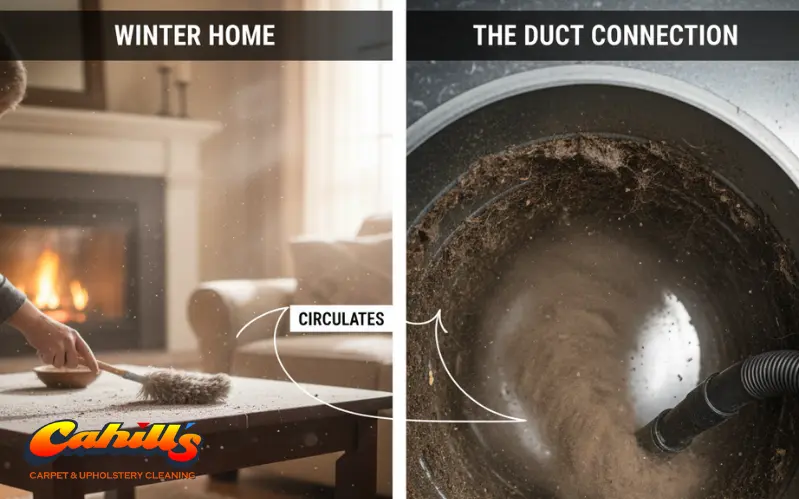
Here’s what most homeowners don’t realize: the dust isn’t coming from outside. It’s coming from inside your home—specifically, from your duct system. Every time your heating system kicks on, it’s circulating air through miles of ductwork that may be harboring years of accumulated dust, debris, pet dander, and allergens. Your HVAC system isn’t just heating your home; it’s distributing contaminants throughout every room, every time it runs.
The good news? Once you understand why this happens, there’s a proven solution. Here’s what our IICRC-certified technicians—with an average of 11 years of experience each—have learned from decades of helping Huntingdon Valley homeowners breathe easier.
What ‘Winter Dust Syndrome’ Really Looks Like
Winter dust accumulation is more than just an annoyance—it’s a sign that something in your home’s air circulation system isn’t working properly. Understanding what you’re dealing with is the first step toward solving it.
Common symptoms of a winter dust problem include: dust that reappears within 24 to 48 hours of cleaning, visible dust particles floating in sunlight near heating vents, a dusty or musty smell when your furnace kicks on, dust accumulating more heavily in rooms farther from your furnace, and black or gray discoloration around your supply registers and return vents.
You might also notice health-related symptoms that worsen during winter months: increased sneezing and congestion indoors, allergy symptoms that improve when you leave the house, dry, irritated eyes that seem worse at home, and waking up with a scratchy throat or stuffy nose. According to the Asthma and Allergy Foundation of America, eight out of ten Americans are exposed to dust mites, and these microscopic creatures thrive in the warm, humid environments created by winter heating systems.
Homeowners throughout Doylestown, Warminster, Jenkintown, Abington, and the surrounding communities experience these same symptoms every winter. The common thread? Their heating systems are running constantly, and their ductwork has become a distribution network for accumulated contaminants.
The Real Causes: Why Your Home Gets Dustier in Winter
In our 45+ years serving Philadelphia area families, we’ve identified several interconnected factors that create the perfect storm for winter dust accumulation. Understanding these causes explains why your cleaning efforts may not be working—and points toward the real solution.
Your Heating System Runs Constantly (And Your Ducts Are Full of Debris)
During summer months, your air conditioning might cycle on and off periodically. But when temperatures drop into the 20s and 30s here in Bucks County and Montgomery County, your heating system runs almost continuously. Every time it runs, air moves through your ductwork—and whatever is sitting inside those ducts gets pushed out into your living spaces.
According to industry research, a typical six-room home can accumulate up to 40 pounds of dust annually just from daily living activities. Much of this dust settles inside air ducts, where it accumulates year after year. Your ducts are essentially acting as a reservoir, storing dust until your heating system activates and distributes it throughout your home.
Your Home Is Sealed Tight (Trapping Allergens Inside)
To save on heating costs, most homeowners keep windows and doors tightly sealed during winter. While this conserves energy, it also eliminates natural ventilation that would otherwise help clear airborne particles. The American College of Allergy, Asthma and Immunology notes that keeping doors and windows shut seals allergens indoors, and your heating system simply recirculates that same air throughout your home.
This creates a closed-loop system where dust, pet dander, dust mites, and other allergens have nowhere to escape. They circulate through your ducts, settle on surfaces, get stirred up by activity, and then recirculate again. Without fresh air exchange, these contaminants build up to levels that can be significantly higher than outdoor air pollution.
Dry Winter Air Keeps Dust Airborne Longer
Forced-air heating systems dramatically reduce indoor humidity levels. When air is dry, dust particles become lighter and stay airborne much longer than they would in humid conditions. Research confirms that dust flows freely through dry air and travels much farther through HVAC systems. When humidity is higher, dust settles faster and has more opportunities to get trapped in filters. But in the dry winter air of a heated Pennsylvania home, dust can travel from your furnace through your entire duct system and into every room before it settles.
Leaky Ductwork Is Pulling In Unfiltered Air
Here’s a cause many homeowners never consider: your ductwork may have gaps, holes, or disconnected joints that are pulling in unfiltered air from your attic, basement, or crawl space. According to Energy Star, typical homes lose 20 to 30 percent of the air moving through their ductwork due to leaks. These leaks don’t just waste energy—they actively pull in dust, insulation particles, and other contaminants from unconditioned spaces and distribute them throughout your home.
In older homes throughout Jenkintown, Glenside, Willow Grove, and other established Montgomery County neighborhoods, ductwork that’s 30 or 40 years old may have developed significant leaks at joints and connections. Every time your furnace runs, these leaks are introducing contaminated air directly into your living spaces—completely bypassing your air filter.
Your Filter Can’t Keep Up (Or It’s the Wrong Type)
Many homeowners rely on their furnace filter to capture dust before it circulates through the home. But here’s what most people don’t realize: standard filters with low MERV ratings allow fine particles to slip right through. And even high-quality filters can’t capture dust that’s already sitting inside your ductwork downstream of the filter. Once contaminants are in your ducts, no filter can remove them—they just keep getting distributed every time your system runs.
Additionally, during heavy winter use, filters clog faster. A dirty filter not only stops trapping new particles effectively—it can actually push trapped particles back into your airstream, making your dust problem worse instead of better.
How to Tell If Your Ducts Are the Problem: A Self-Assessment Guide
Before calling for service, you can perform a simple inspection to determine whether your ductwork might be contributing to your winter dust problem. Here’s what to look for:
First, examine your supply registers—these are the vents where heated air blows into your rooms. Remove the register cover and look inside with a flashlight. If you see visible dust buildup, debris, or discoloration on the interior surfaces of the duct, that’s a clear sign of accumulated contamination.
Second, check your return vents—usually larger vents that pull air back to your furnace. These are often located on walls or ceilings. Dusty, dirty, or discolored return vents indicate that your system is pulling contaminated air back through the ductwork.
Third, look at your furnace filter. If it’s getting dirty faster than usual—say, within two to three weeks instead of one to three months—your ducts may be releasing excessive dust into the system.
Finally, place a white tissue or paper towel over a supply vent and run your system for 15 minutes. If the tissue shows visible gray or black discoloration, dust is actively being distributed through your ductwork.
When should you call a professional? The National Air Duct Cleaners Association recommends professional duct cleaning every three to five years for most homes, and more frequently if you have pets, allergies, recent renovations, or have never had your ducts cleaned. If your self-assessment reveals visible contamination, or if you’re experiencing persistent dust problems despite regular cleaning and filter changes, it’s time to have a professional evaluate your system.
The Solution: How Professional Duct Cleaning Eliminates Winter Dust
Once you understand that your ductwork is the source of your winter dust problem, the solution becomes clear: you need to remove the accumulated contaminants at their source. Here’s what that looks like:
What You Can Do Yourself: Maintenance Between Professional Cleanings
While professional duct cleaning is the most effective solution, there are steps you can take to manage dust between professional services. Change your furnace filter monthly during heavy winter use instead of waiting the standard three months. Use filters with a MERV rating of at least 8, which captures most common household dust particles. Vacuum your supply and return register covers regularly, and wipe down the visible portions of ductwork near each vent. Consider using a humidifier to maintain indoor humidity between 30 and 50 percent, which helps dust settle faster and reduces static electricity that keeps particles airborne.
These measures help manage symptoms, but they can’t address the root cause: the accumulated debris inside your ductwork that no filter or vacuum can reach.
The Professional Solution: Complete Source Removal
Professional air duct cleaning uses specialized equipment to remove accumulated dust, debris, and contaminants directly from your ductwork. The process involves a thorough inspection of your entire HVAC system, followed by mechanical agitation to loosen debris from duct surfaces. Powerful vacuum equipment—often truck-mounted systems that generate significantly more suction than household vacuums—then removes the loosened contaminants from your duct system.
Recent industry research has demonstrated significant benefits from this source removal approach. Studies have shown 41 to 60 percent reductions in blower wheel energy consumption and supply airflow increases of 10 to 46 percent after professional cleaning. The EPA now recognizes source control—removing contaminants at their origin—as one of three essential strategies for healthy indoor air, alongside improved ventilation and effective filtration.
At Cahill’s Carpet & Upholstery Cleaning, our air duct cleaning service addresses your entire HVAC system, not just the visible portions of your ductwork. Our technicians clean supply and return ducts, registers and grilles, and can identify issues like leaky connections that may be contributing to your dust problem.
Why Professional Duct Cleaning Makes Sense for Philadelphia Area Homeowners
The EPA emphasizes that improperly cleaned air ducts can actually make indoor air quality worse rather than better. Using inadequate equipment or improper techniques can release more contaminants into your home or damage your ductwork. This is why professional service from experienced technicians matters.
When your ducts are professionally cleaned, you’re not just eliminating visible dust—you’re removing the source of ongoing contamination. Many of our customers report that for the first time in years, they can go more than a day without seeing dust accumulate on their furniture. For families with allergies or asthma, the improvement in indoor air quality can be life-changing.
Why Philadelphia Area Homeowners Trust Cahill’s for Air Duct Cleaning
Since Bill Cahill founded Cahill’s Carpet & Upholstery Cleaning in 1980 with a single truck and a commitment to professional service, our family-owned company has built a reputation for thoroughness and integrity throughout Huntingdon Valley, Bucks County, Montgomery County, and Philadelphia.
Our 45+ years of experience mean we understand the unique challenges facing Philadelphia area homes—from the older housing stock in established neighborhoods like Jenkintown and Glenside to the newer developments throughout Bucks County. We know that many homes in our service area have ductwork that’s decades old and may never have been professionally cleaned.
Every technician at Cahill’s is IICRC certified and bonded, with an average of 11 years of experience. Our team doesn’t just perform a service and leave—we take the time to explain what we find and provide recommendations for maintaining your indoor air quality year-round.
Our commitment to professional service has earned us the 2023 Community’s Choice Award and Nextdoor Neighborhood Favorite recognition in multiple years. We maintain 5-star ratings across Google, Yelp, Angi, and Nextdoor, and the majority of our business comes from satisfied customer referrals—families who trust us enough to recommend us to their neighbors, friends, and family members.
As one long-time customer shared: “We were lucky to get the owner, Bill, to come out to our house—he’s clearly very experienced, and a real professional. He really knows his business, and is a delightful person to boot.”
Frequently Asked Questions About Winter Dust and Duct Cleaning
How often should air ducts be cleaned in Bucks County homes?
The National Air Duct Cleaners Association recommends professional duct cleaning every three to five years for most homes. However, homes with pets, allergy sufferers, smokers, or recent renovations may benefit from more frequent cleaning every two to three years. If you’ve never had your ducts cleaned, or if you’re experiencing persistent dust problems, scheduling an inspection is the best first step.
How much does air duct cleaning cost in the Philadelphia area?
Costs vary based on the size of your home, the complexity of your duct system, and the level of contamination. Cahill’s provides free estimates—most can be given over the phone by calling (215) 355-5388. Be wary of extremely low-price offers, which often indicate incomplete service or bait-and-switch tactics.
Will duct cleaning help with allergies?
While individual results vary, removing accumulated dust, pet dander, dust mites, and other allergens from your ductwork can significantly improve indoor air quality. Many allergy sufferers report reduced symptoms after professional duct cleaning, particularly when combined with regular filter changes and humidity control.
How long does air duct cleaning take?
Most residential duct cleaning services take between two to four hours, depending on the size of your home and the complexity of your system. Our technicians work efficiently while ensuring thorough cleaning of all accessible ductwork.
Can I clean my air ducts myself?
While you can clean visible register covers and the first few inches of visible ductwork, household vacuums don’t have the power to reach deep into your duct system or remove adhered debris. Professional equipment generates significantly more suction and includes specialized tools designed to agitate and remove contaminants throughout your entire duct system. The EPA warns that improper cleaning techniques can actually make air quality worse.
What’s the best time of year to have ducts cleaned?
Many homeowners schedule duct cleaning in fall before heavy heating season begins, or in spring before air conditioning use increases. However, if you’re experiencing dust problems now, there’s no need to wait—professional cleaning provides immediate benefits regardless of the season.
Will cleaning my ducts reduce my energy bills?
Clean ductwork allows your HVAC system to operate more efficiently. Research has shown that duct cleaning can reduce blower motor energy consumption by 41 to 60 percent and improve airflow by 10 to 46 percent. While individual results vary, improved airflow means your system doesn’t have to work as hard to heat or cool your home.
Does Cahill’s also offer dryer vent cleaning?
Yes. Cahill’s provides professional dryer vent cleaning, which removes lint buildup that can create fire hazards and cause your dryer to work inefficiently. Many customers schedule duct cleaning and dryer vent cleaning together for comprehensive service.
Ready to Breathe Easier This Winter?
If your Bucks County, Montgomery County, or Philadelphia home has been battling persistent winter dust, the solution may be simpler than you think. Your ductwork could be the hidden source of the problem—and professional cleaning can provide relief.
Key takeaways to remember: Winter dust problems are often caused by contaminated ductwork distributing debris throughout your home every time your heating system runs. Sealed homes, dry air, leaky ducts, and overloaded filters all contribute to the problem. Professional duct cleaning removes contaminants at the source, providing lasting relief. Regular maintenance between cleanings helps manage indoor air quality year-round.
Call Cahill’s Carpet & Upholstery Cleaning Today
(215) 355-5388
Free Estimates | 24/7 Answering Service for Emergencies
Serving Huntingdon Valley, Doylestown, Warminster, Jenkintown, Abington, Willow Grove, and all of Bucks County, Montgomery County & Philadelphia
Trusted Since 1980 — Family-Owned Excellence