
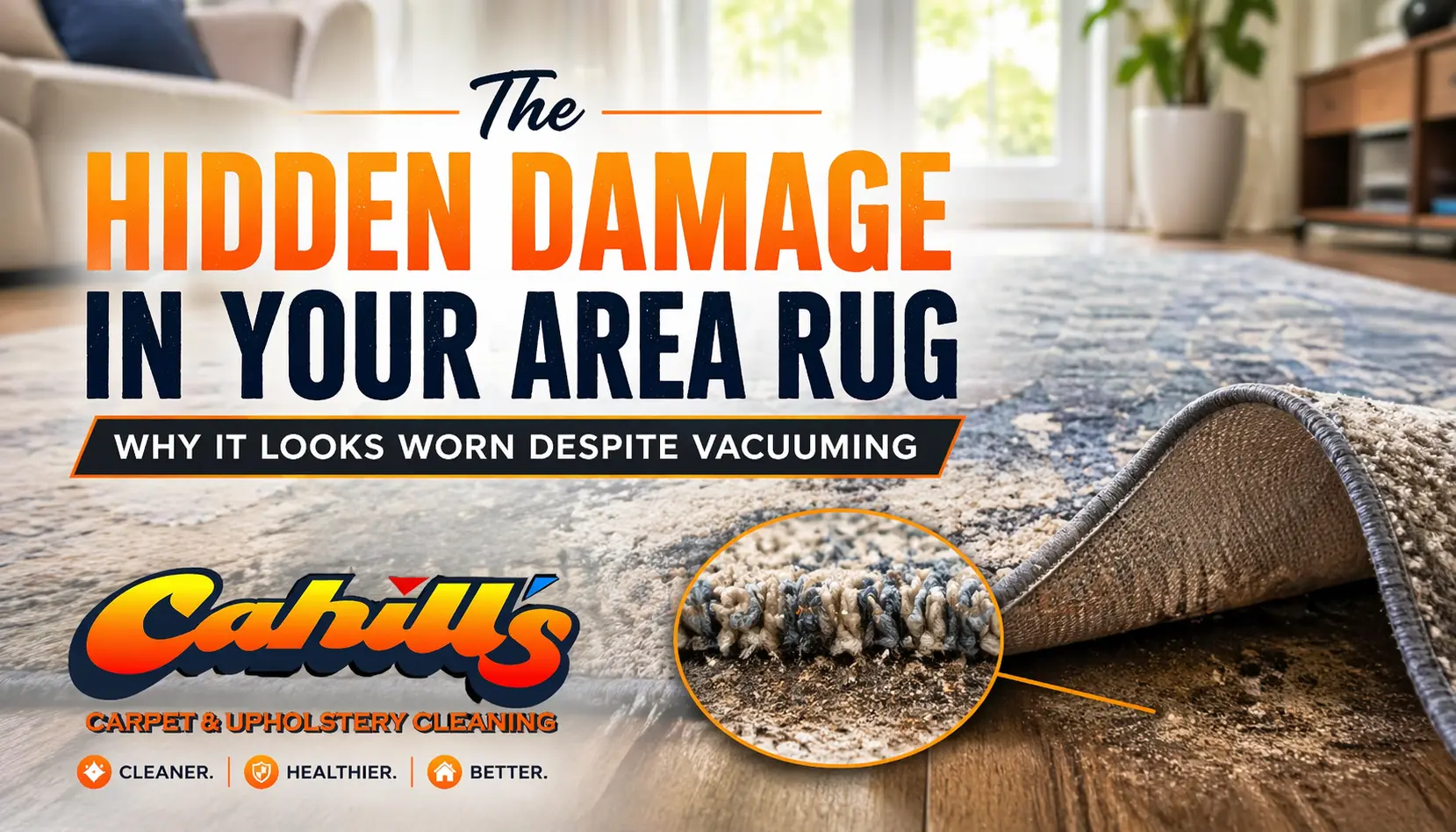
You vacuum it every week. Maybe twice a week. You flip it, rotate it, even run the vacuum in both directions the way you’ve read you should. But your area rug still looks flat, dull, and worn — older than it actually is.
If that sounds familiar, you’re not alone. It’s one of the most common frustrations we hear from Philadelphia, Bucks County, and Montgomery County homeowners when they call Cahill’s. And here’s what 48+ years in the professional cleaning industry has taught us: the problem isn’t your vacuuming routine. It’s what vacuuming cannot reach.
Area rugs trap contaminants deep in their fiber structure that a vacuum’s suction was never designed to extract. Over time, that hidden accumulation acts like an abrasive working from the inside out — breaking down fibers, dulling colors, and making your rug look prematurely aged. This article explains exactly what’s happening, how to recognize it, and what it takes to genuinely restore an area rug to the way it’s supposed to look.
What You’ll Learn
- Why vacuuming leaves most of the damaging material behind
- The four hidden causes of premature area rug wear
- How to assess whether your rug is experiencing hidden damage
- What professional area rug cleaning actually does that vacuuming can’t
- Why Cahill’s free pickup and delivery makes professional cleaning easier than you think
- Frequently asked questions from Philadelphia-area homeowners
What “Worn-Looking” Really Means for Your Area Rug
When an area rug looks worn, most homeowners assume it’s a fiber quality issue or simply age. But in our experience serving thousands of Philadelphia, Bucks County, and Montgomery County homes, the culprit is almost always something else entirely: deeply embedded contamination that regular vacuuming never touched.
Here’s what that actually looks like in your home:
- Colors that looked rich and saturated when you bought the rug now appear dull or faded, even in areas that get little direct sunlight
- The pile feels flat or matted down rather than soft and full, even after vacuuming
- Traffic patterns — pathways through a living room or the area in front of a sofa — look visibly darker and more compressed than the rest of the rug
- An odor that persists no matter how recently the rug was vacuumed, especially in pet households
- A fine, dusty haze visible when you beat the rug or carry it outside in strong light
- Fibers that look frayed or broken at the tips in high-traffic areas
If any of these match what you’re seeing, your rug has accumulated the kind of deep contamination that only professional cleaning can address. The good news: in most cases, rugs that appear worn can be significantly restored. The damage isn’t always permanent.
Why Your Area Rug Looks Worn Despite Vacuuming: The Real Causes
Vacuuming removes loose surface debris — the crumbs, hair, and light dust sitting on top of the pile. What it cannot do is reach the contaminants that have worked their way down into the fiber structure and the rug backing. Here’s what’s actually happening in your rug.
1. Dry Soil Accumulation Below the Vacuum’s Reach
Fine dry soil — the microscopic particles of dirt, sand, dust, and grit tracked in from outside — is heavier than it looks. Over time, foot traffic presses these particles down through the pile fibers toward the base of the rug and into the backing. Standard vacuum suction lifts surface material, but it can’t pull particles out of the lower fiber layers.
This sub-surface dry soil is the single biggest cause of premature fiber wear in area rugs. Every step on the rug causes those embedded particles to shift and grind against the fibers from below. It’s a slow abrasion happening under the surface that you can’t see — but you absolutely see the result over time as pile that becomes increasingly flat and fibers that look frayed at the tips.
In our experience serving Bucks County and Montgomery County homes, a rug that hasn’t been professionally cleaned in two or more years can hold several pounds of this embedded dry soil per square yard. Vacuuming addresses a fraction of it. The rest stays put.
2. Pet Dander, Allergens, and Biological Contaminants
Area rugs are particularly effective at trapping biological material: pet dander, pollen, dust mite waste, skin cells, and bacteria. These particles are small enough to pass through most vacuum filters or bypass suction entirely by clinging to fiber walls deep in the pile.
For pet owners in Philadelphia and throughout Bucks County, this problem is compounded significantly. Pet dander and hair work into the base of rug fibers and resist vacuum extraction. Pet urine — even from accidents that seemed minor at the time — soaks down to the rug backing and padding, where odor-causing bacteria thrive. The surface may look fine. Vacuuming may temporarily reduce odor. But the source of the problem is out of reach.
This biological accumulation doesn’t just cause odors — it degrades fibers over time and can trigger allergy symptoms in sensitive household members, making your rug a hidden indoor air quality issue.
3. Moisture and Residue from DIY Spot Cleaning
Most homeowners have spot-cleaned their area rug at some point — a spilled glass of wine, a muddy paw print, a food stain. The instinct to act fast is correct. But the cleaning products and methods used for spot treatment frequently cause secondary problems that compound over time.
Soap-based cleaners leave a sticky residue in rug fibers that acts as a dirt magnet — the treated area re-soils faster than the surrounding rug, creating a shadow of the original stain that seems to return. Over-wetting during spot cleaning pushes the stain deeper into the pile and backing rather than lifting it. Some consumer stain removers contain optical brighteners or bleaching agents that subtly alter fiber color and break down natural dye bonds over repeated use.
After years of spot treatments, many rugs have an uneven, patchy appearance in formerly stained areas — a result of the cleaning itself, not just the original stains.
4. The Wrong Vacuum — or the Right Vacuum Used Incorrectly
Not all vacuums are created equal for area rugs, and even a good vacuum can cause damage when used incorrectly. Vacuums with rotating brush rolls (beater bars), which are excellent for carpet, can be too aggressive for delicate or hand-knotted rugs — pulling at fibers and accelerating pile wear. High-suction vacuums used on lightweight rugs can distort the rug structure and loosen foundation threads over time.
Vacuuming too infrequently is also a problem — dry soil that sits becomes compacted and harder to lift — but so is vacuuming certain rug types too aggressively. The right vacuuming approach depends on the rug’s construction, pile height, and fiber type. This is one reason professional cleaning, which includes a proper inspection of your rug’s construction before any treatment, matters.
How to Assess Your Area Rug’s Condition
Use these quick checks to evaluate whether your area rug has hidden damage beyond what vacuuming can address:
- Take the rug outside and beat it firmly — a hand or a broom handle works fine. If a significant cloud of dust and debris releases that your vacuum wasn’t capturing, embedded dry soil is a confirmed issue.
- Fold a corner of the rug backward and look at the base of the fibers. If the fiber roots appear darker or grayer than the pile tips, sub-surface soil accumulation is present.
- Press your palm firmly into a traffic area and hold for 10 seconds, then lift. A dusty residue on your palm indicates deep soil that suction isn’t reaching.
- Compare a protected area of the rug (under furniture, along a wall) to a traffic zone. A significant color difference points to embedded contamination in the traffic area, not fiber fading.
- Take note of any persistent odor after vacuuming, particularly a musty, earthy, or ammonia-like smell. This indicates biological contamination — mold, bacteria, or pet urine — that cannot be vacuumed out.
Two or more of these conditions present means your rug needs professional cleaning, not just a more rigorous vacuuming routine. One condition is worth monitoring; address it before it compounds.
Solution Options for Philadelphia-Area Homeowners
What You Can Do at Home
Good home care habits extend the life of a professionally cleaned rug and slow re-contamination:
- Vacuum regularly — weekly for high-traffic rugs, every 10–14 days for lower-traffic areas. Frequent light vacuuming is more effective than infrequent deep passes.
- Turn off the beater bar or use a suction-only attachment for delicate, hand-knotted, or natural-fiber rugs such as wool, silk, or jute.
- For spills, blot immediately with a clean white cloth — never rub. Work from the outside edge of the spill inward to avoid spreading.
- Use a pH-neutral spot cleaner rather than all-purpose household cleaners on stains. Avoid over-wetting.
- Take rugs outside and beat them two to four times per year to dislodge dry soil that vacuuming misses.
- Use a rug pad underneath — it reduces the grinding action of foot traffic against the rug backing and extends fiber life considerably.
These steps make a real difference in maintenance — but they cannot reverse existing embedded damage or extract the deep contamination already present in a rug that hasn’t been professionally cleaned. Think of home care as protecting a clean rug, not restoring a contaminated one.
What Professional Area Rug Cleaning Actually Does
Professional area rug cleaning is a fundamentally different process from vacuuming — or from the in-home carpet cleaning methods applied to wall-to-wall carpet. At Cahill’s, area rugs are cleaned using a process designed specifically for the construction, fiber type, and condition of each individual rug.
Here’s what the process involves:
- Full inspection before any treatment — fiber type, construction method, dye stability, and existing damage are all assessed. A wool hand-knotted rug from the Doylestown area requires a different approach than a synthetic machine-made rug.
- Dry soil removal prior to wet cleaning — this is the step most home cleaners skip entirely. Removing dry particulate before introducing water prevents soil from turning into mud and being pushed deeper into fibers during the wet cleaning process.
- Full-immersion hot water extraction (where appropriate for the rug type) — this reaches the fiber base and backing, flushing out the embedded contamination that vacuuming and surface cleaning leave behind.
- Controlled drying in a monitored environment — proper drying prevents mold and mildew from developing in the backing during the drying process, a common risk with DIY wet cleaning.
- Pile grooming after drying — fibers are groomed back to their natural direction, restoring the pile height and appearance that makes a rug look new again.
The difference in appearance after professional cleaning is often dramatic — colors are noticeably brighter, pile is fuller, and the rug looks years younger. We regularly restore rugs that homeowners were close to discarding, saving them the cost of replacement.
Cahill’s Free Pickup and Delivery: Easier Than You Think
One reason many Philadelphia-area homeowners delay professional area rug cleaning is the logistics of getting a large rug to a cleaning facility. Cahill’s eliminates that obstacle entirely with free pickup and delivery throughout Bucks County, Montgomery County, and the Philadelphia area.
We come to your home, pick up the rug, clean it at our facility using the appropriate method for that specific rug, and return it within the week. One customer described it perfectly: “They came the next day, picked it up, and it was returned the following week. The rug looks brand new and I have two dogs.”
There’s nothing to transport, no equipment to rent, and no risk of over-wetting a rug in your living room and not being able to dry it properly. Call (215) 355-5388 for a free estimate.
Why Philadelphia-Area Homeowners Choose Cahill’s for Area Rug Cleaning
Cahill’s Carpet & Upholstery Cleaning has been serving families throughout Philadelphia, Bucks County, and Montgomery County since Bill Cahill founded the company in 1980 with a single truck. Over 45+ years of professional cleaning experience means our IICRC-certified technicians have seen virtually every rug type, fiber combination, and contamination scenario there is.
- IICRC-certified technicians averaging 11 years of experience — your rug is handled by professionals who know the difference between fiber types and cleaning methods
- Free pickup and delivery throughout Bucks County, Montgomery County, and Philadelphia
- Rug inspection before any cleaning begins — no one-size-fits-all approach
- 45+ years serving the community, recognized as the 2023 Community’s Choice Award Winner
- Nextdoor Neighborhood Favorite, multiple years running
- 5-star ratings on Google, Yelp, Angi, and Nextdoor
- BBB A+ rated and accredited since 2011
- The majority of our business comes from referrals — a track record built on results
Frequently Asked Questions
How much does professional area rug cleaning cost in the Philadelphia area?
Area rug cleaning cost varies based on rug size, fiber type, construction, and the level of contamination present. Cahill’s provides free estimates for most rugs over the phone at (215) 355-5388. Professional cleaning is typically a fraction of rug replacement cost, and the results are often dramatic enough to extend the life of the rug by years.
How often should an area rug be professionally cleaned?
Most area rugs in active Philadelphia-area households benefit from professional cleaning every 12–18 months. Rugs in homes with pets, children, or allergy sufferers should be cleaned every 9–12 months. Decorative rugs in low-traffic areas can go 24 months between professional cleanings if vacuumed regularly and protected from spills.
Can a worn-looking area rug really be restored?
In most cases, yes. What looks like permanent wear is often embedded contamination and flattened pile — both of which professional cleaning addresses. Colors typically become noticeably brighter and pile fuller after proper professional cleaning. Physical fiber damage from extreme abrasion is not reversible, but this is far less common than contamination-related dullness, which is fully treatable.
Why does my rug smell even after vacuuming?
Persistent odor after vacuuming almost always indicates biological contamination — pet dander and urine, mold, bacteria, or dust mite waste — embedded in the fiber base and backing. Vacuuming cannot reach or extract these sources. Professional cleaning with hot water extraction and, when appropriate, enzymatic odor treatment is the only method that eliminates the odor at the source rather than masking it.
Is it safe to clean wool or hand-knotted rugs professionally?
Yes, when cleaned by trained professionals who understand the specific requirements of delicate fiber types. Wool, silk, and hand-knotted rugs require different water temperatures, pH levels, and drying methods than synthetic rugs. Cahill’s IICRC-certified technicians inspect each rug before selecting the appropriate cleaning method — no single process is applied to every rug regardless of type.
What is Cahill’s area rug pickup and delivery process?
Cahill’s picks up your area rug from your home at a scheduled time, cleans it at our facility using the appropriate method for your specific rug, and returns it to you — typically within one week. Pickup and delivery is free throughout Bucks County, Montgomery County, and the Philadelphia area. Call (215) 355-5388 or visit cahillscarpetcleaning.com to schedule.
Is vacuuming hurting my area rug?
Vacuuming is not harmful when done correctly for your rug type. The risk comes from using a rotating brush roll (beater bar) on delicate or hand-knotted rugs, which can pull at fibers over time. For most area rugs, a suction-only attachment or a setting that disables the brush roll is the safer choice. Regular, gentle vacuuming is always better than infrequent aggressive passes.
Do you serve Bucks County and Montgomery County for area rug cleaning?
Yes. Cahill’s 6-truck fleet provides area rug pickup and delivery throughout Bucks County — including Doylestown, Warminster, Newtown, Richboro, Southampton, Langhorne, and Yardley — and throughout Montgomery County, including Jenkintown, Abington, Willow Grove, Glenside, Horsham, and Ambler, plus all Philadelphia neighborhoods. Call (215) 355-5388 to confirm service to your area.
Next Steps: Give Your Area Rug the Deep Clean It Actually Needs
If your area rug looks worn despite regular vacuuming, the issue isn’t your routine — it’s what’s embedded below the surface that vacuuming can’t reach. Here’s what to do next:
- Take the quick beat test: take your rug outside and beat it — if a cloud of debris releases, embedded soil has been accumulating well beyond what your vacuum captures
- Note any persistent odor, traffic-pattern discoloration, or dull, flat-looking pile — these are the signs professional cleaning addresses
- Call Cahill’s at (215) 355-5388 for a free estimate — most provided over the phone
- Ask about free pickup and delivery — we come to you, clean at our facility, and return your rug looking like itself again
- Our 24/7 answering service means we’re always available when you’re ready to schedule
Cahill’s Carpet & Upholstery Cleaning | (215) 355-5388 | cahillscarpetcleaning.com
Serving Philadelphia, Bucks County, and Montgomery County since 1980. Trusted Since 1980 — Family-Owned Excellence.