

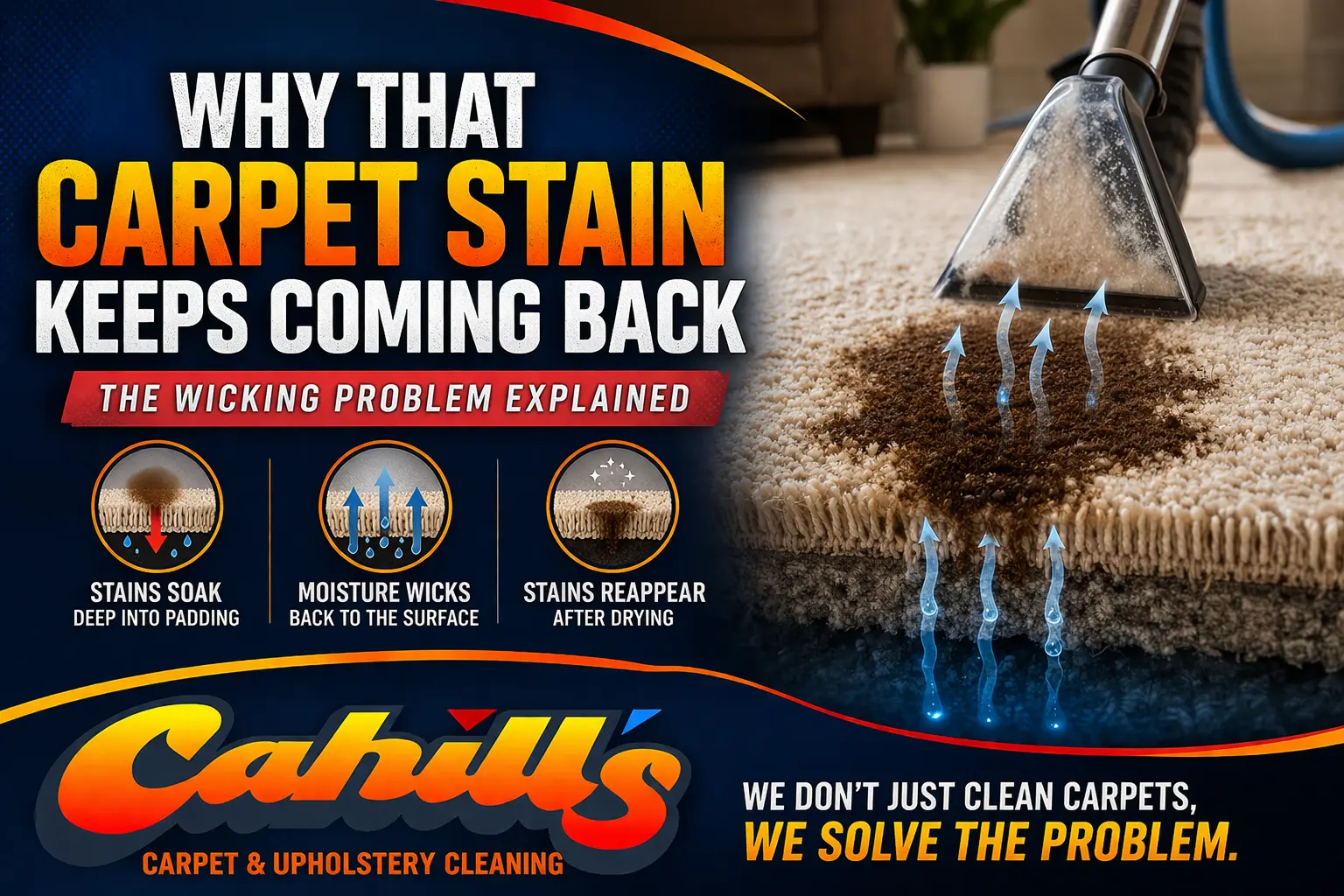
You cleaned the stain. You scrubbed it. Maybe you even rented a carpet cleaning machine from the hardware store. It looked great — problem solved. Then, a few days later, the stain crept back, sometimes darker than before. If carpet stains keep coming back in your Bucks County or Montgomery County home, you’re not alone — and you’re not doing anything wrong.
In our 45+ years serving Philadelphia, Bucks County, and Montgomery County families, recurring stains are one of the most frustrating problems homeowners bring to us. The issue even has a name among carpet cleaning professionals: wicking. It’s not a mystery, and it’s not your fault. But fixing it correctly requires understanding what’s actually happening beneath your carpet’s surface.
Here’s what our IICRC-certified technicians — averaging 11 years of experience each — have learned from solving exactly this problem for thousands of Philadelphia-area homeowners.
What You’ll Learn
- What Is Carpet Wicking and Why Does It Happen?
- The Real Causes Behind Recurring Carpet Stains
- How to Identify a Wicking Problem in Your Home
- Solution Options for Bucks and Montgomery County Homeowners
- Why Philadelphia-Area Homeowners Choose Cahill’s
- Frequently Asked Questions
What Is Carpet Wicking and Why Does It Happen?
Carpet wicking is what happens when a stain that appears to have been removed rises back to the surface of your carpet as it dries. Think of it like a paper towel standing in a puddle — liquid travels upward through the fibers. Your carpet works the same way.
When a liquid spills onto carpet, it doesn’t just sit on top. It soaks through the surface fibers, into the primary backing, and often down into the padding underneath. When you clean only the surface — which is all most DIY methods and low-powered rental machines can reach — you’re removing the part of the stain you can see. The rest stays behind.
As the carpet dries from the top down, capillary action pulls that residual stain back up through the fibers toward the surface. By the time the carpet looks and feels dry, the stain has “wicked” back into view. Common symptoms include:
- Stains that reappear 24–72 hours after cleaning
- Spots that look worse the second time around
- A slightly larger stain outline than the original spill
- Pet odors returning even after the stain appears gone
- A sticky or crunchy texture in the carpet after drying
Wicking can happen with any type of liquid spill — coffee, wine, juice, grease, and especially pet urine. It’s extremely common in high-traffic areas of Philadelphia-area homes and in rooms with pets or young children.
The Real Causes Behind Recurring Carpet Stains
Over the past 45+ years, our technicians have traced recurring stains back to a handful of consistent causes. Understanding these will help you see why some cleaning methods fail — and what it takes to actually fix the problem.
1. Surface-Only Cleaning
The most common cause is simple: the cleaning didn’t reach deep enough. Consumer rental machines and over-the-counter spot removers are designed for surface-level maintenance. Their suction power is a fraction of what professional truck-mounted equipment delivers. When the machine can’t extract moisture and contaminants from the carpet backing, those materials wick back up as soon as the fibers begin to dry.
How to tell: The stain reappears within 48 hours in almost exactly the same spot. The carpet feels damp longer than expected after DIY cleaning.
2. Cleaning Product Residue
Many store-bought carpet cleaners and foam sprays leave a sticky detergent residue behind in the fibers. This residue acts like a magnet for dirt, dust, and debris. The stain that comes back isn’t always the original spill — sometimes it’s fresh soil that’s rapidly bonding to leftover cleaning chemicals. We see this constantly in Bucks County homes where families have applied multiple treatments trying to solve the problem.
How to tell: The area feels tacky or slightly stiff after cleaning. The reappearing stain looks darker than the original and continues to attract dirt even after it dries.
3. Deep Saturation into the Padding
Large spills, flooding, and especially pet urine don’t just soak into the carpet — they penetrate the primary backing and saturate the padding beneath. The padding is essentially a sponge. No amount of surface cleaning will reach it. This is particularly common in Montgomery County and Bucks County homes with pets. The odor-causing bacteria live in the padding, which is why pet odors keep returning even when the carpet surface looks clean.
How to tell: The stain is accompanied by a lingering odor, even after cleaning. The affected area is larger than the original spill appeared. The problem persists through multiple professional cleanings.
4. Overwetting the Carpet
Ironically, using too much water can make wicking worse. When a carpet is overwetted — which happens frequently with portable rental machines and DIY steam cleaners — there’s simply more moisture to push deeper contaminants back to the surface. Overwetting also extends drying time dramatically, giving wicking more time to work. In humid Philadelphia-area summers, an overwetted carpet can take two to three days to fully dry, which significantly increases wicking risk.
How to Identify a Wicking Problem in Your Home
Before calling anyone, run through this quick self-assessment to confirm you’re dealing with wicking and gauge how serious the situation is.
- Did the stain disappear after cleaning, then reappear within a few days? (Classic wicking)
- Is the reappeared stain roughly the same size or slightly larger than the original?
- Is there an odor, even though the stain looks clean?
- Does the area feel sticky or attract new dirt faster than surrounding carpet?
- Have you treated the same spot multiple times without lasting results?
- Is the original stain from a pet, a large liquid spill, or something that soaked in before you got to it?
If you answered yes to two or more of these, you’re almost certainly dealing with wicking. Three or more yes answers — particularly if odor is involved — suggest deep saturation that requires professional hot water extraction to fully resolve.
Solution Options for Bucks and Montgomery County Homeowners
What You Can Try First
For minor wicking from small, fresh spills, a few DIY steps may help slow or reduce the problem:
- Blot — never rub. Use a clean white cloth and work from the outside of the stain inward.
- Apply cold water sparingly. Avoid overwetting.
- Place a thick stack of white paper towels weighted down with a heavy book over the stain. Leave for several hours to draw remaining moisture upward before it wicks.
- Use the complimentary Cahill’s spot remover (provided to every customer) for regular maintenance between cleanings.
Important: DIY methods address only surface residue. They will not resolve wicking caused by deep saturation into the backing or padding. If the stain has already returned once, DIY is unlikely to provide a lasting fix.
The Professional Solution: Hot Water Extraction
Professional hot water extraction — commonly called steam cleaning, though no actual steam is used — is the only method that reliably resolves carpet wicking. Here’s why it works where everything else fails:
- Truck-mounted equipment generates suction far beyond what any rental machine can produce, extracting moisture and contaminants from deep in the carpet backing.
- Professional pre-treatment breaks down the stain at the fiber level before extraction begins.
- Controlled water volume prevents overwetting, which reduces drying time to 6–12 hours in most Philadelphia-area homes.
- Enzymatic treatments for pet-related stains break down urine crystals at the molecular level — eliminating odor at the source rather than masking it.
For cases with deep padding saturation — particularly from pet urine over a long period — we’ll give you an honest assessment. Sometimes padding replacement is the most cost-effective long-term solution. We’ll tell you exactly what your situation needs, whether that’s extraction alone, enzymatic treatment, or padding work.
Why Philadelphia-Area Homeowners Choose Cahill’s
Bill Cahill founded Cahill’s Carpet & Upholstery Cleaning in 1980 with a single truck and a straightforward commitment: fix the problem correctly, the first time. Over 45+ years later, that hasn’t changed. Cahill’s now operates a 6-truck fleet serving Philadelphia, Bucks County, and Montgomery County — the majority of our business coming from the referrals of satisfied customers, many of whom have trusted us for 20–35+ years.
What separates Cahill’s when it comes to wicking and recurring stains:
- IICRC-certified, bonded technicians averaging 11 years of experience — they’ve seen every wicking situation imaginable
- State-of-the-art truck-mounted equipment that extracts from the backing, not just the surface
- Honest inspection — we’ll tell you upfront what’s causing the problem and what it will take to actually fix it
- Furniture protection with blocks and tabs included at no extra charge
- Complimentary bottle of spot remover with every cleaning visit
- 2023 Community’s Choice Award Winner, Nextdoor Neighborhood Favorite, and 5-star ratings on Google, Yelp, Angi, and Nextdoor
- BBB A+ rating since 2011
As one long-time Cahill’s customer put it: “My current home — I just recently replaced my carpets after 20 years and they actually still looked great… definitely a credit to Cahill for doing a great job keeping them clean and in great condition.” That’s what professional cleaning done right looks like over the long term.
Frequently Asked Questions
Why do carpet stains keep coming back after I clean them?
Carpet stains return because of a process called wicking. When a liquid soaks deep into the carpet backing or padding, surface cleaning only removes the top layer of the stain. As the carpet dries, capillary action pulls the remaining stain back up through the fibers to the surface. Professional hot water extraction is the only reliable way to remove the stain at its source and prevent it from returning.
Can I fix carpet wicking myself?
For minor fresh spills, blotting with a clean cloth and applying light cold water can reduce wicking. However, if the stain has already returned once, DIY methods are unlikely to provide a lasting solution. Consumer rental machines lack the suction power to extract moisture from the carpet backing, which is where wicking originates. A professional cleaning by Cahill’s is the most effective way to resolve recurring stains.
How much does professional carpet cleaning cost in Bucks County?
Cahill’s provides free estimates for most jobs over the phone — just call (215) 355-5388. Pricing depends on square footage, the number of rooms, and whether specialty treatments (such as enzymatic pet odor treatment) are needed. Most homeowners in Bucks County and Montgomery County find professional cleaning significantly more affordable than it costs to replace carpet that could have been restored.
How long does professional carpet cleaning take?
Most residential carpet cleaning jobs in Montgomery County and Bucks County take between one and three hours depending on the size of the home and the number of rooms being cleaned. Carpets typically dry within 6 to 12 hours. Cahill’s technicians will explain the process, expected dry time, and any care instructions before they leave.
Is steam cleaning the same as hot water extraction?
Not exactly — though the terms are often used interchangeably. True steam uses vapor above 212°F, which would damage most carpet fibers. Hot water extraction uses hot water heated to an appropriate temperature along with cleaning solution and high-powered suction to deep clean carpet fibers and backing. It’s the method recommended by IICRC and the most effective process available for removing embedded stains, allergens, and wicking residue.
What causes pet stain odors to return after carpet cleaning?
Pet urine soaks through carpet fibers, through the backing, and into the padding beneath. Surface cleaning — including many professional services using portable equipment — doesn’t reach the padding. Odor-causing bacteria and urine crystals remain in the padding and reactivate when moisture is introduced. Cahill’s uses enzymatic treatment in combination with truck-mounted extraction to break down urine at the molecular level, eliminating the odor at its actual source.
When should I call a professional for recurring carpet stains?
Call a professional when a stain has returned after at least one cleaning attempt, when odor accompanies the recurring stain, when the affected area is large or involves pet urine, or when the same spot keeps attracting new dirt despite cleaning. The sooner a professional addresses a deep stain or wicking problem, the better the outcome. Waiting allows stains to set further into the backing and padding.
How often should I have my carpets professionally cleaned to prevent staining problems?
For most Philadelphia-area families, every 12 to 18 months is a reasonable baseline. Households with pets should consider every 6 to 9 months. Homes with young children or allergy sufferers benefit from every 9 to 12 months. Regular professional cleaning prevents soil buildup that makes stains and wicking more likely over time. Cahill’s has customers whose carpets have lasted 20+ years with consistent professional maintenance.
Next Steps: Stop the Wicking Cycle for Good
If carpet stains keep coming back in your Bucks County, Montgomery County, or Philadelphia home, the answer isn’t more spot treatment — it’s addressing what’s happening below the surface. Key takeaways:
- Wicking occurs when cleaning doesn’t reach the backing or padding where the real stain lives
- DIY and rental machines lack the extraction power to fix deep wicking problems
- Hot water extraction with professional-grade truck-mounted equipment is the proven solution
- The sooner you call, the better the outcome — especially for pet-related stains
Call Cahill’s Carpet & Upholstery Cleaning at (215) 355-5388 for a free estimate. Most estimates are provided over the phone. Our 24/7 answering service means we’re always available for emergencies. Serving Philadelphia, Bucks County, and Montgomery County since 1980.