
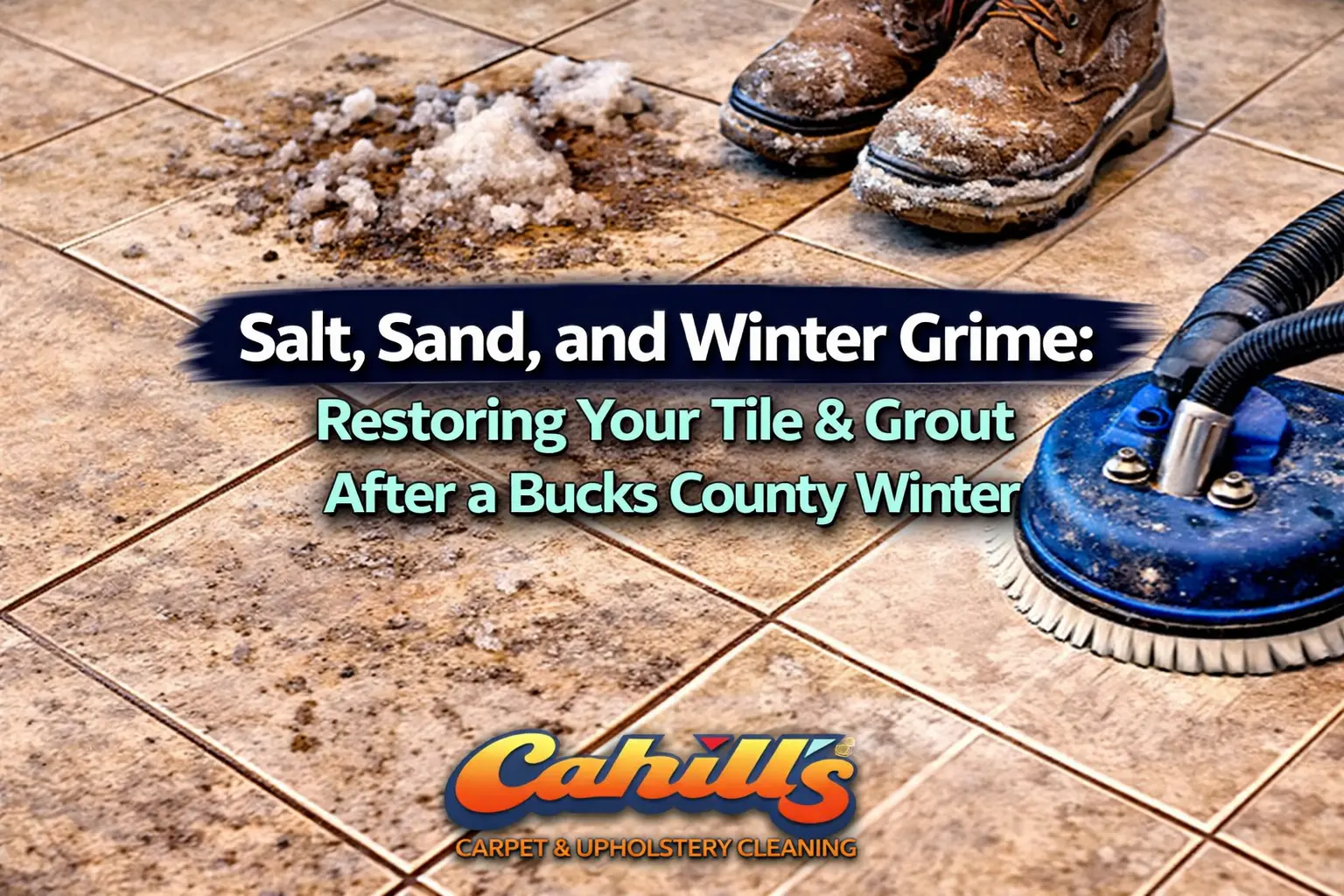
You track it in without even thinking about it. Every trip through the back door from November through March brings salt crystals, sand, road grit, and mud from Bucks County’s winter streets straight onto your tile floors. By the time spring arrives, your grout lines look gray or brown instead of white, your tile surface has lost its shine, and no amount of mopping seems to make a real difference.
If your tile floors are looking dull, discolored, or grimy after this past winter, you’re not imagining it — and you’re not alone. In our 45+ years serving Philadelphia, Bucks County, and Montgomery County families, we hear this complaint every spring without fail. The good news: what looks like permanent damage usually isn’t. Here’s exactly why winter takes such a toll on your tile and grout, and what it takes to actually fix it.
What You’ll Learn
- Why salt, sand, and winter grime are so damaging to tile and grout
- The real causes behind that post-winter grout discoloration
- How to assess whether your tile and grout need professional attention
- DIY steps that help — and what makes them fall short
- How Cahill’s professional tile and grout cleaning restores floors completely
- Frequently asked questions from Bucks County homeowners
What Winter Does to Bucks County Tile & Grout
Tile is tough — but it’s not invincible. And grout, the porous material filling the gaps between your tiles, is particularly vulnerable to what a Bucks County winter throws at it.
When road salt and sand get tracked in from driveways, sidewalks, and parking lots throughout Doylestown, Warminster, Newtown, and the rest of the county, those particles don’t just sit on the surface. They get pressed into grout lines with every step, every shuffle, every piece of furniture dragged across the floor. Salt is corrosive. Sand is abrasive. Together, they work like sandpaper against your grout from the inside out.
Common signs your tile and grout need post-winter attention:
- Grout lines look dark gray, brown, or black — regardless of the original color
- Tile surface appears dull or hazy even right after mopping
- Visible grit or residue in the texture of grout lines
- Salt-haze or white chalky residue on tile near entryways
- Grout lines in high-traffic areas look noticeably worse than elsewhere
- Musty or damp odor from bathroom or kitchen tile floors
Left unaddressed, this buildup doesn’t just look bad. Grout that’s been abraded and contaminated becomes harder to clean over time, more susceptible to mold and mildew, and can eventually crack or crumble — turning a cleaning problem into a much more expensive repair.
The Real Causes Behind Post-Winter Tile & Grout Damage
Understanding why your tile and grout look this bad after winter — despite regular mopping — comes down to a few interconnected causes our technicians see repeatedly throughout Bucks County, Montgomery County, and the Philadelphia area.
1. Grout Is Porous by Design
Most residential grout is cementitious — meaning it’s made from a cement-based material that contains thousands of microscopic pores. Those pores are what allow grout to bond well when installed, but they also act like a sponge for everything your floor contacts. Salt water from tracked-in snow melt, soil particles, cleaning residue, and bacteria all absorb directly into grout’s surface and settle in those pores.
Standard mopping moves surface dirt around, but the water-and-detergent solution rarely penetrates deep enough to lift contaminants out of the pores. What looks clean after mopping is often just the surface layer — the embedded grime stays put.
2. Road Salt Leaves a Chemical Residue That Builds Up
The sodium chloride used on Bucks County roads and driveways doesn’t just wash away cleanly. When salt-laden water dries on tile, it leaves behind a crystalline residue that bonds to the tile surface. Over a full winter of repeated wet-dry cycles, this residue builds up layer by layer. That’s the chalky, hazy film you see on entryway tile that won’t seem to buff out.
Salt residue also attracts moisture, which means it keeps pulling additional contaminants into grout even after you’ve cleaned. The result is a cycle of re-contamination that regular mopping can’t break.
3. Sand and Grit Act as an Abrasive
Sand and cinder applied to icy roads throughout Warminster, Langhorne, and Southampton all winter long ends up ground into your floors by foot traffic. This isn’t just a staining issue — it’s a physical abrasion issue. Over months, that grit literally scours the surface of grout, roughening the texture and creating more surface area for future staining to grip. Grout that has been abraded this way stains faster and more deeply than grout in protected areas.
4. Cleaning Products Leave Their Own Residue
Many homeowners attack the post-winter grime with stronger cleaning products — often making things worse. Soap-based cleaners leave a sticky film that actually traps new dirt faster. Bleach-based products can lighten grout unevenly and degrade the grout surface over time, making it more porous. Highly acidic cleaners can etch the surface of certain tile types.
By spring, many Bucks County homeowners are dealing not just with winter contamination but also with cleaning product buildup on top of it — a double layer that requires professional-grade equipment and techniques to address properly.
How to Assess the Condition of Your Tile & Grout
Before deciding on a course of action, do a quick walk-through of your tile floors with these checkpoints:
- Compare grout color in a protected area (under a rug or inside a cabinet) to a high-traffic zone. A significant color difference indicates deep contamination, not just surface dirt.
- Run your finger along a grout line. Gritty texture means abrasive particles are embedded. Sticky texture suggests cleaning product residue buildup.
- Mop a small section and observe how quickly it looks dirty again. Rapid re-soiling is a sign that the grout is holding contaminants at the surface level.
- Check for white or chalky haze on tile near entryways or sliding doors — this is salt residue.
- Inspect bathroom or kitchen grout for any dark spots or discoloration that could indicate mold or mildew taking hold in compromised grout.
If you’re finding two or more of these conditions, your tile and grout are past the point where DIY cleaning will fully restore them. That doesn’t mean you shouldn’t try the steps below first — but you’ll want to know when it’s time to call in professional help.
Solution Options for Bucks County Homeowners
DIY Steps Worth Trying First
For mild post-winter buildup, these steps can make a noticeable difference:
- Dry sweep or vacuum before any wet cleaning — removing loose sand and salt particles first prevents grinding them deeper during mopping.
- Use a pH-neutral tile cleaner, not a soap-based or bleach-based product. These clean without leaving residue or damaging grout.
- Scrub grout lines with a stiff-bristle grout brush (not a metal brush). Focus on one section at a time.
- Rinse thoroughly with clean water after scrubbing. Leaving cleaning solution on grout accelerates re-soiling.
- For salt haze on tile, a diluted white vinegar solution (1:1 with water) can help break down salt residue on ceramic and porcelain tile — but avoid using vinegar on natural stone.
Be realistic about what DIY cleaning can accomplish: it will improve surface appearance but will not extract deeply embedded contaminants from porous grout. For heavily contaminated grout or large-area discoloration, professional cleaning is the only method that fully restores the original color.
What Professional Tile & Grout Cleaning Accomplishes
At Cahill’s Carpet & Upholstery Cleaning, our professional tile and grout cleaning uses truck-mounted hot water extraction equipment — the same high-powered system we use for carpet cleaning — combined with specialized rotary cleaning heads and professional-grade cleaning solutions designed specifically for tile and grout surfaces.
Here’s what the process looks like for Bucks County homeowners:
- Pre-inspection: Our IICRC-certified technicians examine your tile type (ceramic, porcelain, natural stone, etc.) and grout condition before selecting the appropriate cleaning approach.
- Pre-treatment application: A professional-strength solution is applied to break down embedded salt residue, grime, and biological contaminants in the grout pores.
- High-pressure hot water extraction: Our truck-mounted system delivers pressurized hot water into grout lines while simultaneously vacuuming out the dislodged contamination. This is what penetrates and extracts — not just moves — the embedded grime.
- Targeted stain treatment: Any problem areas — heavy traffic zones, entryways, areas near sliding doors — receive additional attention.
- Post-cleaning inspection: We walk through the results with you and address any areas that need additional attention.
- Optional sealing: After cleaning, we can apply a grout sealer that fills those microscopic pores and creates a protective barrier against future contamination — dramatically reducing how quickly grout re-soils.
The result is grout that returns to something very close to its original color — not the muted gray or brown it had become after winter, but the actual installed color underneath all that contamination.
Why Professional Cleaning Makes Financial Sense
Tile and grout replacement is significantly more expensive than professional cleaning — often by thousands of dollars for a kitchen or bathroom floor. Homeowners throughout Jenkintown, Abington, and Willow Grove are often surprised to discover that floors they thought needed replacing can be fully restored with professional cleaning.
Adding a grout sealing service after professional cleaning extends the time between necessary cleanings and protects your investment in the floor itself. It’s a fraction of the replacement cost with comparable results.
Why Philadelphia Area Homeowners Choose Cahill’s for Tile & Grout Cleaning
Cahill’s Carpet & Upholstery Cleaning has served families throughout Bucks County, Montgomery County, and the Philadelphia area since Bill Cahill founded the company in 1980 with a single truck. Today, our 6-truck fleet handles tile and grout cleaning for homeowners from Doylestown to Norristown to Philadelphia neighborhoods every week.
What sets Cahill’s apart:
- IICRC-certified technicians with an average of 11 years of experience — they know the difference between a floor that needs cleaning and one that needs additional repairs
- Truck-mounted equipment delivering professional-grade pressure and extraction unavailable with consumer machines
- 45+ years of serving the community — recognized as the 2023 Community’s Choice Award Winner in Bucks and Montgomery Counties
- Nextdoor Neighborhood Favorite recognition across multiple years
- 5-star ratings on Google, Yelp, Angi, and Nextdoor
- Majority of our business comes from referrals — a reflection of consistent, trustworthy results
- BBB A+ rating, accredited since 2011
As one long-time customer put it: “Cahill carpet cleaning has been cleaning my carpets for over 35 years. They are simply the best in the business. My carpets lasted 20+ years — definitely a credit to Cahill for keeping them in great condition.” We bring that same commitment to every tile and grout job.
Frequently Asked Questions
How much does professional tile and grout cleaning cost in Bucks County?
Cost varies based on the area to be cleaned, tile type, and grout condition. Most residential jobs in Bucks County fall within a range that’s a fraction of what tile replacement would cost. Cahill’s provides free estimates — most over the phone at (215) 355-5388 — so you know exactly what to expect before scheduling.
How long does professional tile and grout cleaning take?
For a typical kitchen or entryway floor, professional tile and grout cleaning takes between one and three hours depending on the size and condition of the area. Floors are generally ready to walk on within 30–60 minutes after cleaning is complete. Our technicians will give you a specific time estimate when they assess your floor.
Can I clean grout myself, or do I need a professional?
DIY grout scrubbing with a stiff brush and pH-neutral cleaner can maintain relatively clean grout between professional cleanings. However, once grout has deep contamination from a full winter of salt, sand, and grime, consumer-grade cleaning cannot extract embedded particles from the pores. If the grout color has shifted significantly or re-soils very quickly after cleaning, professional extraction is needed.
Why does my grout look dark even after I clean it?
Dark grout after cleaning is almost always a sign of deeply embedded contamination that surface cleaning can’t reach. The grout’s porous structure has absorbed soil, salt residue, and possibly mold or mildew that have discolored the material itself. Hot water extraction at professional pressure levels is typically required to pull these contaminants out and restore the original grout color.
Should I seal my grout after cleaning?
Yes — grout sealing after professional cleaning is one of the best investments you can make in your floors. Sealer fills the microscopic pores in grout, creating a barrier that dramatically reduces how quickly contamination re-embeds. Sealed grout stays cleaner longer, is much easier to maintain with routine mopping, and resists mold and mildew more effectively. Cahill’s can apply grout sealer as part of the same service visit.
How often should tile and grout be professionally cleaned?
For most Bucks County homeowners, a professional tile and grout cleaning once a year — ideally in spring after winter grime season — keeps floors in excellent condition. High-traffic entryways or homes with pets and young children may benefit from cleaning every 9–12 months. Sealed grout can often go longer between professional cleanings.
Do you serve all of Bucks County for tile and grout cleaning?
Yes. Cahill’s 6-truck fleet serves all of Bucks County, including Doylestown, Warminster, Richboro, Southampton, Feasterville-Trevose, Newtown, Yardley, Langhorne, Holland, Churchville, and all surrounding communities. We also serve Montgomery County, Philadelphia, and parts of New Jersey. Call (215) 355-5388 to confirm service to your location.
Is steam cleaning safe for all tile types?
What’s commonly called “steam cleaning” is actually hot water extraction — not literal steam. Our IICRC-certified technicians inspect your tile type before selecting cleaning temperatures and pressure levels appropriate for your specific surface. Ceramic and porcelain tile handles this process very well. Natural stone such as marble or travertine requires a more controlled approach, which our experienced technicians are trained to provide.
Next Steps: Restore Your Tile & Grout This Spring
If your tile floors are showing the aftermath of a Bucks County winter, spring is the ideal time to restore them before another season of foot traffic bakes the contamination in deeper. Here’s what to do:
- Note the problem areas: entryways, kitchen floors, bathrooms, laundry rooms — anywhere you’ve noticed dark grout or dull tile
- Call Cahill’s at (215) 355-5388 for a free estimate — most provided right over the phone
- Ask about grout sealing as part of the service to protect your floors going forward
- Schedule at your convenience — our 24/7 answering service means we’re always available, including for emergencies
Cahill’s Carpet & Upholstery Cleaning | (215) 355-5388 | cahillscarpetcleaning.com
Serving Philadelphia, Bucks County, and Montgomery County since 1980. Trusted Since 1980 — Family-Owned Excellence.