
You mop. You mop again. You switch cleaners, try a different mop head, scrub on your hands and knees. And within a day or two, the kitchen or bathroom tile feels sticky underfoot all over again — especially on humid summer days.
If that sounds familiar, here’s the most important thing to understand: the mopping is almost certainly part of the problem, not the solution. Sticky tile floors in summer are one of the most common complaints we hear from homeowners throughout Philadelphia, Bucks County, and Montgomery County — and in nearly every case, the stickiness is caused by cleaning product residue that mopping alone keeps reapplying rather than removing.
In our 45+ years of professional tile and grout cleaning, we’ve seen this cycle in homes across Doylestown, Jenkintown, Warminster, and throughout the Philadelphia area. The good news is that once you understand what’s actually causing sticky tile — and break the cleaning cycle that perpetuates it — the fix is more straightforward than most homeowners expect.
What You’ll Learn
- Why tile floors become sticky in summer specifically — and what humidity has to do with it
- The four real causes of sticky tile, including the cleaning product cycle most homeowners don’t realize they’re in
- How to assess which cause applies to your floors
- DIY steps that actually work — and why the first step may surprise you
- What professional tile and grout cleaning resolves that mopping cannot
- Frequently asked questions from Bucks County and Montgomery County homeowners
What “Sticky Tile” Actually Means
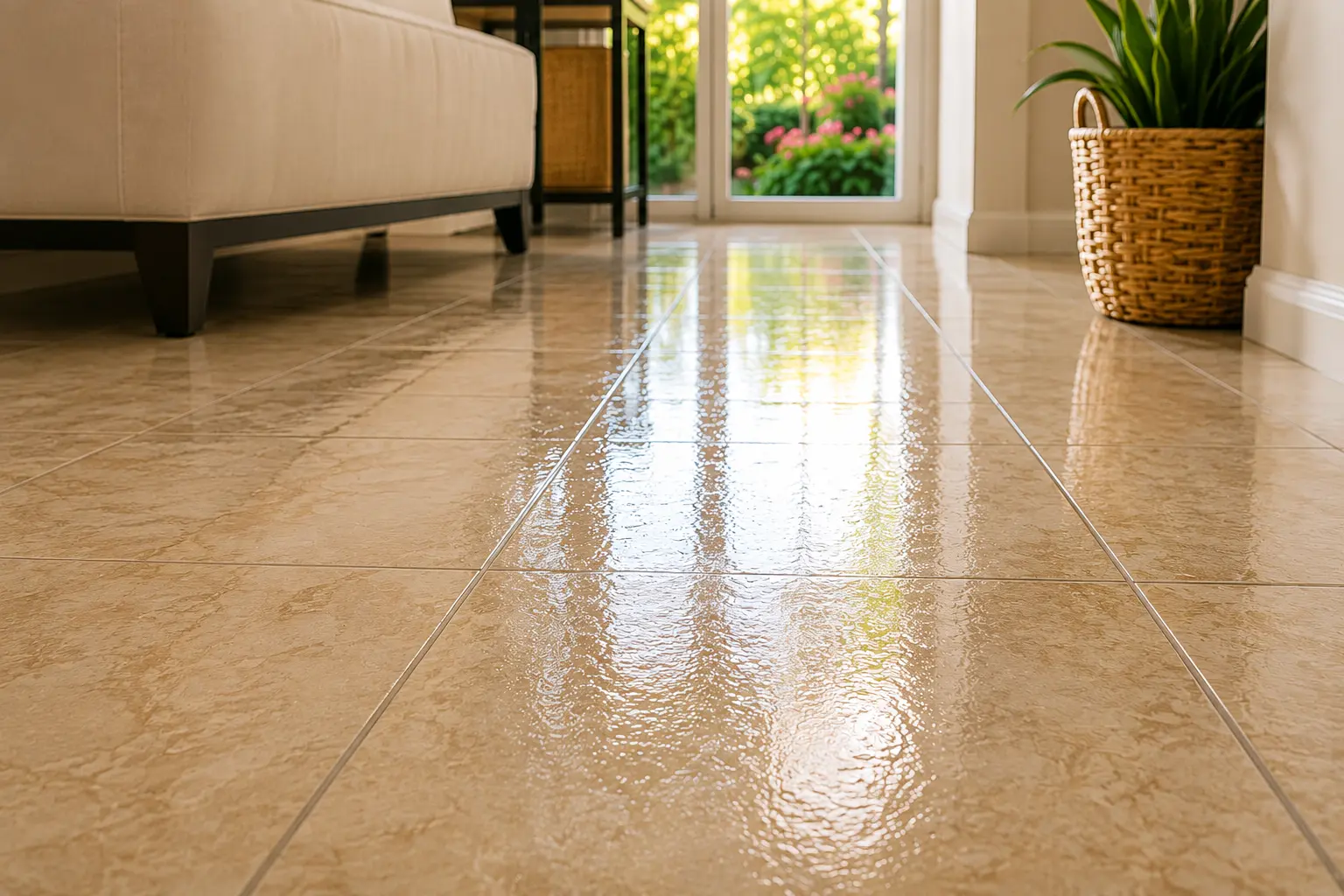
Tile itself — ceramic, porcelain, or natural stone — is a non-porous surface that should feel smooth and dry underfoot after mopping. When it feels tacky, slightly grippy, or leaves a faint residue on bare feet, something is coating the surface that shouldn’t be there. The tile isn’t inherently sticky; something has been deposited on or in the tile surface that becomes tacky, particularly under the elevated humidity and warmth of a Philadelphia-area summer.
Signs that confirm your tile has a sticky residue problem:
- The stickiness is worse on humid days or after the AC has been running — humidity activates residue that feels dry on cool, dry days
- Floors feel sticky shortly after mopping, sometimes within hours
- A faint haze or film is visible on tile in raking light, even right after cleaning
- Grout lines look darker than they should and don’t fully lighten after mopping
- Bare feet pick up a faint residue or feel slightly dirty after walking across a freshly mopped floor
- Switching cleaning products temporarily improves the situation but stickiness returns within days
Three or more of these matching your situation confirms a residue buildup problem that requires a different approach than standard mopping. Here’s what’s actually causing it.
Why Tile Floors Feel Sticky in Summer: The Real Causes
Sticky tile in summer is almost never a single-cause problem. It’s typically a combination of factors that reinforce each other — which is why switching products or mopping more frequently doesn’t break the cycle.
1. Soap and Detergent Residue Buildup — The Most Common Cause
Most consumer floor cleaning products — including popular name-brand tile cleaners, multi-surface sprays, and pine-based cleaners — contain surfactants (soap-based compounds) designed to lift and suspend dirt in water. In theory, when you mop and the water evaporates, the dirt leaves with it. In practice, a thin film of surfactant residue remains on the tile surface with every mop pass.
Over weeks and months of regular mopping, these residue layers accumulate. Each new mop pass deposits another layer on top of the previous ones. The result is a soap film on the tile surface that is inherently tacky — that’s what surfactants do, they’re designed to attract and hold particulate. On cool, dry days the film may feel slightly dull but not noticeably sticky. In summer humidity, the film absorbs ambient moisture and becomes noticeably tacky underfoot.
This is the primary cause of sticky tile throughout Bucks County and Montgomery County homes in summer, and it’s entirely self-perpetuating: the more you mop with a soap-based cleaner, the worse the residue buildup becomes.
2. Too Much Cleaning Product Per Mop Pass
Even the right cleaning product, used in excess, produces residue buildup. Most tile floor cleaners are designed to be diluted significantly — often a capful per gallon of water. Many homeowners use two to three times the recommended concentration under the assumption that more cleaner equals cleaner floors. The result is proportionally more surfactant residue deposited with each pass.
Spray mops that apply concentrated product directly to the floor are particularly prone to this issue. The product is applied full-strength to one section of floor, spread by the mop, and the water evaporates — leaving concentrated surfactant residue behind rather than the diluted trace amount a properly mixed bucket solution would leave.
3. Humidity Activating Existing Surface Residue
Philadelphia-area summers deliver sustained humidity that directly affects how residue on tile surfaces behaves. Surfactant films that feel dry and relatively unnoticeable in low humidity conditions absorb moisture from humid air and become hygroscopic — meaning they actively attract and hold additional moisture. This moisture-laden residue feels distinctly tacky underfoot, particularly on warm, humid July and August days throughout Bucks County and the wider Philadelphia area.
This is why sticky tile often feels like a summer-specific problem even though the residue causing it has been building all year. The humidity threshold that makes the residue feel tacky is simply reached in summer and not in winter — making summer the season when the underlying buildup problem becomes impossible to ignore.
4. Dirty Mop Water Re-Depositing Soil and Residue
A mop that starts in a bucket of clean water becomes progressively more contaminated with each pass across the floor. By the time you’ve mopped a kitchen or bathroom, the mop water contains the soil you’ve lifted from the floor — plus the cleaning product residue from previous mop sessions. Continuing to mop with dirty water re-deposits a mixture of old soil and accumulated residue across the floor surface.
This problem is compounded by mop heads that haven’t been adequately cleaned between uses. A mop head carrying residue from the previous cleaning session adds that residue to the fresh cleaning solution before the first mop pass. Microfiber mop heads that aren’t washed regularly become repositories of the same surfactant buildup that’s coating the floor.
How to Identify What’s Causing Your Sticky Tile
Before treating sticky tile, a quick assessment identifies the severity of residue buildup and confirms the cause:
- The water bead test: drop a small amount of plain water on the tile surface and observe. On clean, residue-free tile, water beads up or spreads in a consistent sheet. On a tile surface with residue buildup, water spreads unevenly, sheets poorly, or leaves a milky trace as it dries. Significant residue produces a visible film as the water droplet dries.
- The white cloth test: wipe a clean white cloth firmly across a section of floor that appears dry and recently mopped. A faint gray, yellowish, or soapy residue on the cloth confirms surface buildup.
- The vinegar test: mop a small test section with a solution of 50% white vinegar and 50% water, allow to dry, and check the feel. Vinegar is acidic and dissolves soap-based residue. If the test section feels noticeably less sticky than the surrounding floor after drying, soap residue is confirmed as the primary cause.
- The humidity correlation check: note whether stickiness is significantly worse on high-humidity days versus low-humidity days. Strong correlation with humidity confirms that residue is present and being activated by ambient moisture — a characteristic of surfactant film buildup.
If the vinegar test confirms soap residue and the residue is mild to moderate, home treatment can address it effectively. If the buildup is significant — visible haze, heavy stickiness, grout lines that are noticeably discolored — professional tile and grout cleaning is the faster and more complete solution.
How to Fix Sticky Tile Floors: What Actually Works
Step 1: Stop Using Soap-Based Cleaners
The first and most important step is counterintuitive: stop mopping with the product you’ve been using. Continuing to apply soap-based cleaner to floors that already have surfactant buildup adds more residue to the problem. No amount of additional mopping with a soap-based cleaner will remove soap-based residue.
Switch permanently to a pH-neutral tile floor cleaner — formulated without soap-based surfactants — for routine maintenance. pH-neutral cleaners clean effectively without leaving the residue film that causes stickiness. They’re widely available at home improvement stores and are the professional standard for tile maintenance between deep cleanings.
Step 2: Strip the Existing Residue with White Vinegar
White vinegar is a mild acid that dissolves soap-based residue effectively without damaging ceramic or porcelain tile. For moderate residue buildup:
- Mix a solution of equal parts white vinegar and warm water in a bucket
- Mop the floor in sections, allowing the solution to dwell on each section for 2–3 minutes before continuing
- Follow immediately with a clean water rinse using a second mop or clean mop head — this step is critical and often skipped; without rinsing, vinegar residue replaces soap residue
- Dry the floor with clean towels or a microfiber dry mop to prevent water marks
- Repeat if the first pass doesn’t fully resolve the stickiness — significant buildup may require two or three vinegar treatments to fully strip
Important: do not use vinegar on natural stone tile (marble, travertine, limestone). The acid in vinegar etches stone surfaces permanently. For natural stone, a pH-neutral stone cleaner is the appropriate choice.
Step 3: Address the Grout Lines
Grout accumulates the same soap residue as tile — but more of it, because grout is porous and the residue penetrates rather than sitting on the surface. Stiff-bristle grout brush scrubbing with a vinegar solution addresses surface and shallow grout residue. However, grout that has years of embedded residue and soil — visible as persistent dark discoloration that doesn’t lighten with vinegar treatment — requires the extraction pressure of professional cleaning to fully address.
Step 4: Clean and Replace Your Mop Head
A mop head that has been used with soap-based cleaners carries residue that re-deposits on the floor with every use. Wash microfiber mop heads in hot water without fabric softener (fabric softener coats microfiber and reduces its cleaning effectiveness). If the mop head is more than a few months old or has heavy buildup, replace it. Starting the new cleaning routine with a fresh mop head ensures you’re not re-introducing the residue you just stripped.
When Professional Tile and Grout Cleaning Is the Right Call
For floors with years of residue buildup, or where grout lines are significantly discolored, home treatment can improve but not fully resolve the problem. Professional tile and grout cleaning by Cahill’s IICRC-certified technicians uses truck-mounted hot water extraction equipment that reaches the grout at a pressure and temperature level consumer methods can’t match.
Here’s what professional tile and grout cleaning accomplishes that home treatment cannot:
- High-pressure hot water injection followed by simultaneous extraction — this physically dislodges and removes embedded residue from grout pores rather than simply rinsing the surface
- Rotary cleaning heads that reach every grout line consistently, including corners and edges that a mop head can’t clean effectively
- Professional-grade pre-treatment solutions formulated to break down specific types of residue and soil before extraction
- Thorough rinse and extraction cycle that removes cleaning agents along with the residue — no new film deposited during the cleaning process
- Optional grout sealing after cleaning — a sealer fills grout’s pores and prevents future residue and soil from penetrating, dramatically reducing how quickly grout re-soils and how sticky floors become between cleanings
Many homeowners who have struggled with sticky tile for years — trying every product on the market without lasting improvement — find that a single professional cleaning combined with switching to pH-neutral maintenance cleaner resolves the problem permanently. The tile looks and feels the way it did when it was installed.
Why Bucks County and Montgomery County Homeowners Choose Cahill’s for Tile and Grout
Cahill’s Carpet & Upholstery Cleaning has served families throughout Philadelphia, Bucks County, and Montgomery County since Bill Cahill founded the company in 1980 with a single truck. Tile and grout cleaning is one of the services we’ve refined over 45+ years — it requires the same professional-grade extraction equipment and technician expertise as carpet cleaning, applied to a surface type with its own specific challenges.
- IICRC-certified technicians with an average of 11 years experience — able to identify the cause of sticky tile quickly and select the appropriate treatment
- Truck-mounted hot water extraction delivering pressure and temperature levels that remove embedded grout residue completely
- Optional grout sealing service following professional cleaning — a protective step that prevents residue from penetrating grout pores and dramatically reduces future stickiness
- Free estimates for most jobs over the phone at (215) 355-5388
- 6-truck fleet serving all of Bucks County, Montgomery County, and Philadelphia
- 2023 Community’s Choice Award Winner in Bucks and Montgomery Counties
- Nextdoor Neighborhood Favorite, multiple years recognized
- 5-star ratings on Google, Yelp, Angi, and Nextdoor | BBB A+ rated since 2011
Frequently Asked Questions
Why do my tile floors feel sticky after mopping?
The most common cause is soap-based cleaner residue that accumulates with each mop pass. Surfactants in standard floor cleaners lift dirt into water but leave a thin film on the tile surface when the water evaporates. Over time this film builds up and becomes tacky, especially in summer humidity. The fix starts with stopping soap-based cleaners and switching to a pH-neutral tile cleaner, then stripping existing buildup with a vinegar solution.
Why is my tile floor sticky only in summer?
The residue causing the stickiness has been building all year — summer humidity is simply what makes it noticeable. Surfactant films on tile are hygroscopic: they absorb moisture from humid air and become tacky. Philadelphia-area summers regularly deliver relative humidity above 70%, which activates residue that feels merely dull or slightly hazy in drier months. The summer stickiness is the symptom; the underlying residue buildup is the year-round problem.
What is the best cleaner for sticky tile floors?
For routine maintenance once residue is removed: a pH-neutral tile floor cleaner, used at the manufacturer’s recommended dilution. For stripping existing soap residue: a 50/50 white vinegar and warm water solution, followed by a clean water rinse. Avoid soap-based, pine-based, and all-purpose household cleaners for tile maintenance — these are the primary cause of residue buildup. For natural stone, use a pH-neutral stone-specific cleaner rather than vinegar.
Will vinegar damage my tile?
White vinegar is safe for ceramic and porcelain tile, which are the most common residential tile types. It should not be used on natural stone (marble, travertine, limestone, slate) because the acid in vinegar etches stone surfaces and causes permanent dull spots. If you have natural stone tile and a residue problem, contact Cahill’s — professional cleaning using pH-neutral stone-safe solutions is the appropriate treatment.
How much does professional tile and grout cleaning cost in Bucks County?
Cost varies based on the area to be cleaned, tile type, and grout condition. Cahill’s provides free estimates for most jobs over the phone at (215) 355-5388 — most homeowners know within a brief call what to expect. For floors where years of residue buildup have made home treatment ineffective, professional cleaning is typically far more cost-effective than continuing to try different products.
Should I seal my grout after professional cleaning?
Yes — grout sealing after professional cleaning is one of the highest-value maintenance steps available. Sealer fills grout’s pores, preventing soap residue, soil, and moisture from penetrating the surface. Sealed grout stays cleaner longer, is easier to maintain with routine mopping, and resists the buildup that causes sticky floors. Cahill’s can apply grout sealer as part of the same service visit.
How long does professional tile and grout cleaning take?
For a typical kitchen floor, bathroom, or entryway, professional tile and grout cleaning takes one to three hours depending on the size and condition of the area. Floors are generally ready to walk on within 30 to 60 minutes after cleaning is complete. Our technicians will advise you on timing for your specific floor area during the service visit.
Do you serve all of Bucks County and Montgomery County for tile cleaning?
Yes. Cahill’s 6-truck fleet serves all of Bucks County — including Doylestown, Warminster, Newtown, Richboro, Southampton, Langhorne, Yardley, Holland, and Churchville — and all of Montgomery County, including Jenkintown, Abington, Willow Grove, Glenside, Horsham, Ambler, Fort Washington, Lansdale, and Hatboro, plus all Philadelphia neighborhoods. Call (215) 355-5388 to confirm service to your area.
Next Steps: Get Tile Floors That Feel Clean and Stay That Way
Sticky tile floors in summer are fixable — and once fixed properly, stay fixed with the right maintenance routine. Here’s where to start:
- Do the vinegar test on a small section: if it temporarily resolves the stickiness, soap residue buildup is confirmed and you have a clear path forward
- Stop using soap-based cleaners immediately — the first and most important step in breaking the cycle
- For mild to moderate buildup, work through the vinegar stripping process and switch to pH-neutral maintenance cleaner
- For significant buildup or heavily discolored grout that home treatment hasn’t resolved, call Cahill’s at (215) 355-5388 for a free estimate
- Ask about grout sealing as part of the professional cleaning service — the step that prevents the problem from returning
- Our 24/7 answering service means you can reach us any time, including weekends
Cahill’s Carpet & Upholstery Cleaning | (215) 355-5388 | cahillscarpetcleaning.com
Serving Philadelphia, Bucks County, and Montgomery County since 1980. Trusted Since 1980 — Family-Owned Excellence.
About the Author
Bill Cahill founded Cahill’s Carpet & Upholstery Cleaning in 1980 with a single truck and a commitment to professional service. Over 45+ years later, he leads a team of IICRC-certified technicians — averaging 11 years experience each — serving Philadelphia, Bucks County, and Montgomery County. Cahill’s was recognized as the 2023 Community’s Choice Award Winner and maintains 5-star ratings across Google, Yelp, Angi, and Nextdoor.