
How to Prepare Curtains for Professional Cleaning: Carpet Cleaning Cost
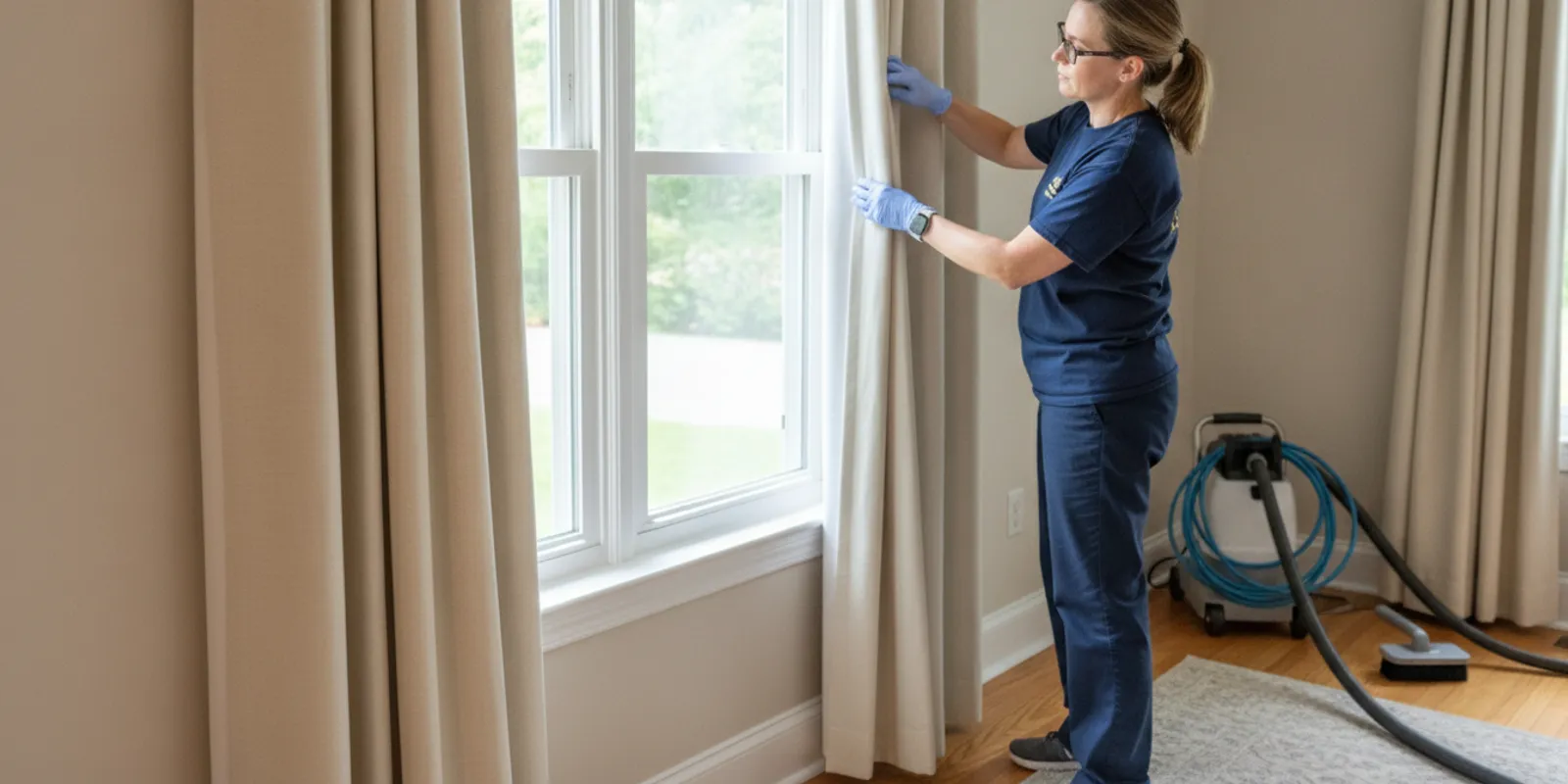
Preparing curtains for professional cleaning starts with the details a cleaner needs to assess the textile, its condition, and access to the window. If you are searching for carpet cleaning cost, keep in mind that a carpet rate does not tell you what drapery care will involve. Curtains have different construction, handling, and access considerations, so the useful first step is to describe the actual panels and request a separate, scoped estimate.
Request a drapery cleaning estimate
What does a useful preparation plan include?
Preparation is not a do-it-yourself cleaning trial. It is a careful handoff of information. Before you request an estimate or arrange an assessment, note what you know about the fabric, how each panel is attached, what concerns you have, and how the cleaner can safely reach the window. Those points help frame a discussion without assuming that every textile can be treated the same way.
Think of one set of curtains as a small project with several parts: the face fabric, lining or backing, decorative features, attachment hardware, window height, nearby furnishings, and the result you want considered. A sheer panel with a simple rod pocket is not the same assessment as a lined, pleated curtain with trim at a high window. Two panels can look similar from across a room and still differ in construction or condition.
Write down what you want reviewed rather than trying to identify the material or stain yourself. For example: “Two lined panels in the living room, a water mark near the lower hem, unknown fiber, high rod.” That gives a cleaner more useful starting point than “clean the curtains.” It identifies quantity, condition, and an access question while leaving technical conclusions to an assessment.
It also helps to distinguish what you have observed from what you suspect. “There is a pale line along the bottom edge” is an observation. “It must be a leak” is a possible explanation. If you do not know the cause or timing, say so. A careful description reduces the risk that an assumption will be treated as established history.
What should you check before requesting an estimate?
Start with a sewn-in care label, manufacturer instructions, purchase paperwork, or notes you kept about the textile. Record fiber or fabric names only if they are actually listed. If no label is visible or you cannot find the paperwork, report that instead of guessing based on appearance or touch. Materials can look alike while responding differently to handling and cleaning.
Check whether the curtains have a separate lining, blackout backing, interlining, or a coating. Do not pull layers apart to investigate. Note what you can see at an edge or from the back, and describe anything uncertain as uncertain. A backing may be an important part of the assessment even when the front fabric looks uncomplicated.
Look at how each panel is made and attached. Possible details to record include pleats, rod pockets, grommets, tabs, rings, hooks, tiebacks, fringe, tassels, embroidery, appliqué, decorative trim, or attached weights. Note whether a component appears sewn in or seems to detach readily, but do not test it by pulling. A cleaner needs to know about features that may require careful handling, not have you disassemble the curtains in advance.
Inspect seams, hems, folds, and areas near the attachment points from a safe position. Record loose threads, repairs, small tears, stretched areas, worn edges, or places where the fabric seems fragile. These details matter to a handling discussion even if the curtain does not look damaged overall. Avoid tugging on a weak seam to see how secure it is.
Look for visible marks, fading, water lines, uneven color, dust, or changes in texture. You do not need to determine the substance or promise that it can be removed. Note where the concern is located: for example, “left panel, lower third, facing the room” or “both panels, top folds near the rod.” A location helps the cleaner inspect the area you mean rather than searching the full set.
Consider the history that may be relevant: direct sunlight, a known spill or leak, prior cleaning, repairs, or sprays and spot products used. Include dates only if you know them. If you inherited the curtains or moved into a property with them already installed, say that the history is unknown. Do not fill gaps with guesses just to make the request sound complete.
Take a few photographs in ordinary room light if it is safe and convenient. One image can show the complete window and surroundings, another can show the attachment and lining, and close views can show specific concerns. Include a sense of scale when useful, but do not climb to take a close-up. Images can support the description; they cannot confirm fiber content, color stability, hidden construction, or the cause of a mark.
How should you build a clear curtain inventory?
Make a short inventory before contacting a cleaner. Count windows and panels as accurately as you can, and separate rooms when the fabrics, condition, or access differ. State whether you want an assessment of every curtain or just one set. For a business, list the rooms or operating areas, approximate window count, and any building or scheduling constraints.
A practical inventory can include these fields:
- Location: room, floor, suite, or facility area.
- Quantity: number of windows and panels, with an approximate count if needed.
- Size or scale: ordinary, unusually wide, long, or heavy, based on what you can observe.
- Construction: lining or backing, pleats, trim, decorative pieces, and attachment type.
- Condition: visible marks, fading, wear, loose seams, odors of concern, or prior repairs.
- History: known exposure, spill, prior cleaning, or products applied.
- Access: height, furniture nearby, stairs, restricted hours, or other practical limits.
- Priority: the main issue you want discussed, without assuming a treatment or result.
For a home, your note might say: “Dining room, two lined pleated panels, tall window, faded area on the side that gets afternoon sun; care label not found.” For a facility it might say: “Reception, six window openings, mixed panel sizes, one mark by the entry, room occupied until 4 p.m.; security desk access required.” These examples are not technical diagnoses. They show how to make the request specific enough for follow-up questions.
Separate different sets rather than compressing them into one vague total. “Three living-room panels, lined, one with a spot” is more informative than “three curtains.” If the office has four matching panels and one different decorative panel, list those as separate groups. A cleaner can then clarify whether the items belong in the same assessment and scope.
When a count is uncertain, give a range and explain why. Perhaps several windows have paired panels and one has a single wide treatment. Say, “I counted eight panels, but two are difficult to distinguish from the side panels.” That is more helpful than presenting an uncertain count as exact. The estimate discussion can confirm which items are included before work is approved.
Keep an inventory copy for yourself. If someone else will meet the cleaner, share the list and photographs in advance. This prevents the person on site from having to reconstruct the request from memory and makes it easier to check that the estimate names the intended rooms and panels.
How can you describe marks and previous treatment?
Describe a mark by its location, appearance, and known history. Useful details include whether it is a small spot or a broad area, whether it is near a hem or fold, when it was first noticed if known, and whether anything was applied afterward. Avoid naming a substance unless you saw what happened or have reliable information about it.
For example, say “a dark mark on the right panel, about halfway down; noticed after a gathering, source unknown.” If a drink spilled and you know what it was, say that and mention any steps you took. If a window was left open during rain, explain that as known context, but avoid assuming every discoloration came from the rain. Separate the event you observed from the cause you cannot confirm.
Make a simple record of products used. A note can include the product name, approximate date, area treated, and whether the color or texture appeared to change. If you still have the packaging, keep it available for the discussion. Do not apply another product to “balance” or remove the earlier one. Multiple treatments can make an assessment harder to interpret.
If the concern is odor rather than a visible mark, explain where it is noticeable and when you notice it. Say whether it affects one panel, a whole window set, or a larger room, and mention any known source. Do not assume an odor proves a particular kind of damage. The cleaner can ask what further information is useful when the cause is not clear.
Photograph a mark without filters or heavy editing. A close image may help show its location and appearance, while a wider image connects it to the panel and room. If the color in a photo looks different from what you see, mention that lighting may be affecting the image. A photograph is a conversation aid, not a substitute for inspecting the actual textile.
Do not scrub a spot to make it more visible or scrape away a deposit. Preserve the current condition for assessment. If a fresh spill occurs, gently blot excess liquid with a clean, absorbent cloth without rubbing, then report what happened and what you did. Do not add heat, steam, or a product as an experiment.
Should curtains come down before an assessment?
Ask the cleaner before removing anything. Do not take down panels automatically. The appropriate plan depends on fabric, construction, access, and the method considered after inspection. Taking down a heavy treatment can put strain on the curtain, rod, or fasteners, and reaching a high attachment can create a fall risk. Do not climb on a chair, table, or unstable furniture.
If the cleaner asks you to remove panels, request clear handling instructions before starting. Confirm whether the request applies to every panel or only a particular set, and ask what to do with detachable hooks, rings, or other small pieces. If you are uncertain how a panel is mounted, send a photo or leave it in place until you receive direction.
When removal is part of the agreed preparation, photograph the full arrangement first. Label each panel by room and window, then note its left-right position or direction if that matters to how it hangs. Keep matching pairs together. A brief map such as “front bedroom: window A, left and right; dining room: one wide panel” can prevent confusion if several sets are similar.
Place detached hardware in a labeled container unless the cleaner gives different instructions. Do not pull at sewn-in trim, remove weights, unpick seams, or detach features that appear integral to the fabric. Avoid tight folding of delicate or embellished panels. Ask how to protect and transport them, especially if you are handling more than one set.
If you are not comfortable taking a panel down, state that clearly. The same applies when the window is high, furniture blocks access, or a curtain seems heavy or fragile. The discussion can then focus on whether an on-site assessment is possible and what access arrangements would be needed. Do not treat removal as the homeowner's responsibility unless that has been agreed.
For a multi-room project, prepare a panel map and keep it with your inventory. A basic table on paper can have columns for room, window, panel count, position, and notes. There is no need for specialized measuring equipment. The goal is to preserve identity and orientation, especially when different sets look alike or have been altered over time.
How can you prepare a home or facility for safe access?
Clear small items from the immediate work area and make an unobstructed path to the window. Move fragile objects off nearby tables and ledges. If a sofa or cabinet blocks the window, mention it before the visit rather than dragging a heavy piece across the floor. Ask whether the cleaner needs space cleared or can work around the furniture, and agree on who will move any heavy item.
Tell the cleaner about ceiling height, narrow stairs, restricted entrances, difficult parking or building access, and any window that is hard to reach. A photo of the full area may help explain a layout, but note any details it cannot show, such as a locked service entrance or a time-limited elevator. The question is not simply whether someone can visit; it is what access will be available and what work area can be prepared.
Protect nearby objects by discussing them in advance. Identify artwork, plants, electronics, window treatments adjacent to the curtains, and other items that should not be moved or touched. Do not assume that every object can be relocated as part of a cleaning service. Agree on responsibility for moving or protecting anything important before work begins.
Keep children and pets away from the work area during inspection and service. If a household member, tenant, or staff member needs to use the room, plan how the space can remain clear. Do not promise access to a room that will be occupied if the person coordinating the visit cannot make it available.
For a business, identify a site contact and describe any sign-in, security, key, or restricted-area procedure. Explain customer hours, room bookings, staff schedules, and any period when the space is unavailable. If work must be coordinated around clients, patients, tenants, or employees, say what the practical limits are without implying that any specific schedule or service method has already been approved.
A facility manager arranging work in several rooms can list locations in the order they can be accessed and identify spaces that need a separate approval. If a meeting room is available only between bookings, provide that limit at the outset. If a reception area cannot be closed during normal operations, ask how the assessment and any proposed work would be coordinated. These facts help clarify feasibility before a scope is accepted.
For an apartment building or managed property, establish who can authorize access and who will be present. Do not assume a tenant, building employee, or property manager has approved work on another person's curtains. List any units or rooms that are outside the request. A written access plan helps keep the estimate tied to the spaces actually being considered.
What should you avoid before a professional assessment?
Do not apply bleach, stain remover, fragrance, fabric refresher, or another cleaning product shortly before an assessment unless the cleaner has advised you to. A product may affect color or texture, and residue can complicate evaluation. Avoid scrubbing: rubbing may spread a substance or change the fabric surface, making it harder to assess the original concern.
Do not machine-wash, steam, iron, or dry the curtains as a test. Heat and moisture can affect fibers, linings, coatings, pleats, and finishes. A care label may give useful instructions, but it is not a reason to assume that every treatment is suitable for the entire assembled curtain. Share the instructions and let the cleaner consider them alongside the item's construction and condition.
Do not detach sewn trim, unpick a seam, cut threads, or try to repair a weak area. A small alteration may change how the panel hangs or complicate a later assessment. If a component seems loose, take a photograph and describe it. Keep any detached piece you already have in a labeled container and tell the cleaner where it came from.
Do not use a home test to decide what the fiber is. Burning a thread, applying water, or rubbing the surface is not an appropriate way to identify an unknown curtain. Such tests can damage the textile or produce an unreliable conclusion. If the label is missing, mark the material as unknown and ask what assessment is available.
Also avoid setting an outcome expectation before anyone has inspected the curtain. The history of a mark may be unclear, and the material may limit what can reasonably be attempted. Ask what the cleaner can evaluate, what uncertainties matter, and whether the proposed scope includes the area of concern. A careful explanation is more useful than an unsupported guarantee based on a short description.
Why is carpet cleaning cost not a drapery price?
Carpet and curtains are both textiles, but they are different projects. Carpet covers a floor and is subject to foot traffic. Curtains hang vertically and may have lining, backing, pleats, trim, hardware, and exposure to sunlight. Their construction, access, handling, and requested scope differ. A carpet cleaning cost cannot be applied as a drapery rate.
There is no universal curtain price to infer from a carpet estimate or a general online guess. Cahill's Carpet & Upholstery Cleaning offers free estimates, with the scope based on the specific area, condition, fabric, and treatment. When requesting an estimate, ask what information or inspection is needed before the work can be described. Do not treat a general starting figure as a complete quote for panels with different construction or condition.
The useful comparison is not “What does a curtain cost per carpeted room?” It is “What specific items and work does this proposal cover?” A floor-cleaning estimate may be organized around rooms or carpeted area. A drapery discussion may need to identify individual windows, panel count, lining, decorative details, access, and whether the curtains remain installed. Different units of work should not be treated as interchangeable.
When comparing proposals, make sure they cover the same curtains. Confirm the rooms, windows, and panels included; whether assessment is part of the process; and how the cleaner will account for fabric, lining, decorative features, and visible concerns. Ask whether the curtains remain in place or are handled separately, and whether removal, transport, or rehanging is included. Do not assume those tasks are included unless the proposal says so.
Ask how additional attention to a mark would be discussed and what happens if inspection changes the proposed scope. Clarify which preparation tasks belong to you, whether access or furniture movement is expected, and what is excluded. A written description is helpful because it lets you compare like with like instead of choosing based on a headline alone.
Here is a sample comparison checklist to use during an estimate conversation:
| Comparison point | Questions to ask | Why it matters |
|---|---|---|
| Panels and rooms | Which windows and panels are included? | Prevents a partial scope from being mistaken for a whole-home project. |
| Material and condition | What fabric details or marks need inspection? | Construction and condition affect the assessment and proposed work. |
| Handling | Will panels stay in place, and who handles removal or rehanging? | Clarifies access, responsibility, and handling expectations. |
| Estimate basis | What specific area, fabric, condition, and treatment does the estimate cover? | Keeps drapery scope distinct from carpet rates or vague assumptions. |
| Changes and limits | How are added work and uncertain outcomes discussed? | Sets expectations before approving a changed scope. |
For example, imagine one estimate covers two living-room windows and another covers every curtain on the first floor. The second may describe a larger scope even if its headline looks attractive. Before comparing them, ask each provider to name the same rooms and panels, clarify whether both proposals include the same handling, and identify any concern that is excluded pending inspection.
Another household might have matching dining-room panels and a separate sheer curtain in a bedroom. If the estimate describes only “three curtains,” confirm which set the count refers to. The written scope should resolve that ambiguity before you approve work. This is especially useful when a property has changed hands and no one knows whether a decorative panel belongs with the main set.
For more information about Cahill's upholstery and drapery cleaning, review the service page and discuss the particular fabric and project. If you are also comparing floor care, keep that request separate; the company's carpet cleaning service has its own assessment and estimate.
How should you compare estimates and ask follow-up questions?
Begin by confirming that every estimate refers to the same inventory. Read the room names and panel counts against your own notes. If one window was left out, or one set has an unusual lining, ask whether it is included. Do not rely on “all curtains” if the property has several floors or a mix of panel types.
Next, ask what information supports the proposed scope. A useful conversation should address what is known about the material, what still needs inspection, which condition concerns are included for review, and what handling is anticipated. If a cleaner cannot determine a detail from the initial description, ask whether the uncertainty affects the estimate or needs an in-person assessment.
Ask how the curtains will be handled, but do not request a particular technique simply because it worked for a different item. The method should be discussed in relation to the fabric and construction. You can still ask practical questions: Will the panels stay installed? If they need to be removed, who will do it? What happens to hooks or rings? How will you know which panels belong at each window when the work is complete?
Discuss the desired outcome in specific, modest terms. You may want the curtains assessed because of general soiling, a visible mark, or a concern about odor. State which of those matters most. Ask what can be evaluated and what limits should be understood, rather than treating a request as a promise that every concern will disappear.
Clarify what happens if the scope changes. For instance, inspection may reveal more panels than the estimate describes, or a backing may differ from what a photo suggested. Ask whether the cleaner will explain the revised scope before proceeding and how you can approve or decline it. This is a communication question, not a prediction that the estimate will change.
Confirm practical responsibilities in plain language: preparation, furniture clearance, access, removal, transport, rehanging, and payment timing if that information is relevant to the proposal. Do not assume that a service includes every task adjacent to cleaning. If a responsibility is not written down, ask for clarification rather than relying on memory.
Keep a brief record of the answers. You can write a few lines in your inventory: “Bedroom pair included; label unknown; cleaner to assess whether panels stay installed; mark by hem noted; furniture will be cleared by homeowner.” The purpose is not to create a complicated contract. It is to make sure that both sides are discussing the same request.
What should homeowners and facility managers ask?
Homeowners can make an estimate conversation more useful with direct questions:
- What care-label or construction details would help you assess these panels?
- Should I leave the curtains installed until you have reviewed the material and access?
- Which rooms, windows, and panels are included in the estimate?
- How will you discuss a mark when its cause or history is uncertain?
- What should I move, protect, or leave in place before an assessment?
- Will the estimate change if inspection reveals additional panels or a different condition?
- How should I label the panels if removal is requested?
- What work or handling is not included in the scope?
These questions are especially useful when a home has more than one fabric type. A homeowner may group matching living-room panels together, note a different bedroom curtain separately, and identify one mark as the priority concern. That gives the cleaner a clear starting point without suggesting that every item should receive identical treatment.
Facility managers may have another layer to consider. Ask who needs to provide access, whether work can be staged by room, how staff or customers will be kept clear of the work area, and whether the estimate names each location. If a building has special security steps or restricted hours, communicate them before the visit. These are coordination questions, not assumptions about a particular service method.
For example, a manager preparing a reception area might list the number of window openings, identify panels with direct afternoon sun, and state the hours when the room is available. A cleaner can then clarify whether the access window is workable and what the estimate covers. If a second-floor meeting room has a different fabric, list it as a separate set rather than blending its requirements into the reception-room description.
A property manager coordinating several apartments should identify which units are part of the request and who will authorize entry. If tenants need advance notice, make that part of the access plan. Do not describe a building-wide project if only some units are approved. An accurate list helps prevent the estimate from including spaces outside the intended work.
For a home with several different curtain types, use the same approach: group matching panels, record exceptions, and identify the one or two concerns that matter most. That keeps the initial assessment focused while leaving room for the cleaner to ask follow-up questions. If no one knows the fabric history, note that rather than delaying the inquiry until you locate information that may not exist.
How does drapery care differ from other textile cleaning?
It is tempting to group carpets, upholstery, and curtains together because they are all fabrics in a home or business. But the way they are used and installed changes the assessment. Carpet is walked on and lies across a floor. Upholstery is fitted over furniture and may include cushions, seams, and other components. Curtains hang from hardware, often near windows, and may include layers, folds, trim, or coatings.
Those differences affect what information is useful. For a carpet request, a customer may describe rooms and floor area. For an upholstery request, it may help to identify the furniture piece and its visible condition. For curtains, the cleaner needs a window-by-window description, panel count, construction details, and access information. Do not assume that one scope or estimate can be transferred to another surface.
Separate surfaces in a combined inquiry. You can say, “I would like an estimate for two curtain sets and the carpet in the adjoining room,” then describe each one in its own line. That makes it easier to discuss whether the work has different inspection needs, preparation responsibilities, or timing. It also avoids the confusion of a single request that never explains which surface has which concern.
If a curtain set is in a room with other cleaning needs, note the relationship without presuming that everything will be handled together. A facility manager might have curtains in an office and carpet in a corridor, but the access windows may differ. A homeowner might want to discuss curtains while also asking about upholstery. The request can mention all of these needs while asking for each one to be scoped accurately.
For a business asking about a broader facility project, distinguish the curtain inquiry from commercial carpet cleaning or other listed services. The relevant page for commercial carpet cleaning describes a separate service category. It does not mean every fabric or room is included in that scope. Name the exact surfaces and locations so the estimate discussion can address them individually.
How do local customers request a scoped estimate?
Cahill's Carpet & Upholstery Cleaning serves customers in Huntingdon Valley, Southampton, Jenkintown, Abington, Willow Grove, Langhorne, and Newtown, as well as Montgomery and Bucks Counties. When you make an inquiry, describe your location, the number and type of panels, visible concerns, and access needs. For a business, identify the facility area and any coordination requirements.
Use the contact page to request an estimate and share what you know. An estimate is free and depends on the specific area, condition, fabric, and treatment. If you are unsure about fiber content or whether panels should be removed, say so. The purpose of preparation is to support an assessment, not to arrive with every answer.
If it is convenient, organize your inquiry as a short message: “I am in \[confirmed service area]. I have \[number] windows and \[number] panels in \[rooms]. The curtains are \[known construction or unknown], and I would like to discuss \[main concern]. The windows are \[access note]. I can share photos and any care-label information I find.” This is a format, not a requirement; use the details you have and leave unknowns open.
Before approving work, read back the scope in plain terms: which curtains, what handling, what preparation, and what treatment is being considered. Ask about anything unclear while there is still time to revise the description. If the request includes more than drapery, name each surface separately so the estimate does not leave you guessing what is covered.
Keep the estimate and your inventory together. If you later add a room or discover another panel, mention the change before assuming that it is part of the original scope. If the priority changes—for example, a newly noticed mark becomes more important than general appearance—tell the cleaner. Clear updates make it easier for both parties to discuss the actual work being considered.
What is a simple step-by-step preparation workflow?
You do not need to finish every task before making an inquiry. Use a short sequence to gather what is available, identify what remains unknown, and avoid making changes that could affect the curtains. The sequence works for one window or several rooms.
- Define the request. Decide which rooms or facility areas you want considered. Separate the curtains from any carpet or upholstery questions, even if you plan to ask about them in the same inquiry.
- Count and group the panels. Record the window, number of panels, and whether a set appears to match another. Mark an uncertain count as approximate.
- Gather existing information. Look for care labels and paperwork without pulling at seams or removing trim. Note lining, backing, attachment type, and visible construction.
- Record the condition. Describe locations of marks, wear, fading, or odor concerns. Add only history you know, including earlier products or cleaning.
- Document access. Note height, furniture, stairs, entry procedures, room schedules, and anything that must not be moved.
- Send the request and ask what comes next. Share the list and useful photos, then confirm whether further inspection or preparation is needed before approval.
After those steps, review the inventory as if a person unfamiliar with the property had to find every set. Could they tell which window is meant? Is the unusual panel described separately? Is the mark's location understandable? If not, add a room name, photo, or simple orientation note. Small clarifications are more valuable than technical guesses.
Do not spend time measuring every fold unless the cleaner requests specific measurements. A rough description such as “wide window with two full-length panels” can be enough to begin a conversation. If exact dimensions are needed to assess the project, ask how to measure safely and what points to include. Avoid climbing or stretching to get a number.
Before a visit, take one final look at the access route and the area around the window. Put away small breakable objects, make the room available at the agreed time, and keep the panel inventory accessible. If a circumstance changes—a room becomes occupied, a building entrance is closed, or a panel is accidentally removed—tell the cleaner before the visit rather than expecting them to discover it on arrival.
Worked example: a home with mixed curtain sets
Suppose a homeowner has paired lined panels in the living room, a sheer curtain in the bedroom, and a decorative treatment in the dining room. One living-room panel has a pale area near the bottom. The first step is not to call all of these “four curtains” and expect them to share one plan. Instead, create three inventory entries: living room, two lined panels, pale area on the left panel; bedroom, one sheer panel, label unknown; dining room, decorative treatment with trim, construction to be reviewed.
The homeowner can photograph each whole window, take a safe close-up of the pale area, and look for care information already attached to the panels. The note should say whether the mark's cause is known and whether any product was used. If no care label can be found, the homeowner writes “unknown” rather than guessing. The panels stay in place until the cleaner gives direction about removal and access.
When the estimate is discussed, the homeowner checks that all three entries are covered and asks whether the unusual trim or unknown label requires a closer inspection. If the quote is limited to the living room, that is a valid scope only if the homeowner understands it is not an estimate for the bedroom and dining room. This simple distinction prevents the total panel count from hiding important differences.
Worked example: a facility with room and access limits
A property manager may have curtains in a reception area and two meeting rooms, with different availability in each space. The inventory can list each location, approximate window count, known construction, and hours when the room is accessible. The manager can identify the site contact, entry process, and rooms that require advance authorization. They can also state whether furniture must remain in place.
When comparing estimates, the manager should check that both providers are discussing the same rooms and that each proposal accounts for the same access limitations. If one meeting room cannot be made available on the proposed date, the manager can ask whether the work should be considered separately rather than treating the whole facility as one uninterrupted project. No specific schedule should be assumed until it is agreed.
The manager should also determine who will confirm that each room is ready and who can approve a change in scope. If the cleaner sees a different panel count or condition than described, there should be a clear contact for discussing it. This is particularly useful when the person requesting the estimate will not be present during the assessment.
What to confirm before you approve the work
Use your notes to make a final check with the cleaner. Confirm the location and identity of each set, the proposed handling, any preparation you are expected to complete, and the concerns that have been discussed. Ask whether any panel remains outside the scope because its construction, condition, or access needs more review. If you are not comfortable with an assumption, pause and clarify it.
Keep the decision focused on the described work. You can approve an estimate for one room and ask for another to be assessed later. You can also ask for an explanation before deciding if a proposed scope changes. Preparation does not require you to authorize every item or to proceed just because you requested an estimate.
After the scope is clear, keep the panel map and any instructions together until the work is complete. If you remove panels as agreed, label them consistently with the estimate. If they remain installed, make sure the access area is prepared as discussed. This final match between the written scope and the room helps avoid preventable confusion about which curtains were meant to be considered.
Review upholstery and drapery cleaning
Frequently asked questions
Do I need to wash curtains before a professional assessment?
No. Do not wash or steam them as a test. Share any care instructions you have and let the cleaner assess the material and condition before a method is agreed.
Should I send photos when I request an estimate?
Photos can show the number of panels, general condition, and access, so they may help explain the request. They cannot confirm fiber content, reveal every construction detail, or guarantee what will happen to a mark during cleaning.
Can I use carpet cleaning cost to estimate curtain cleaning?
No. Carpets and curtains have different construction, access, handling, and scope. Request a separate drapery estimate based on the panels and their condition rather than applying a carpet rate.
Should I remove curtain hooks and rings?
Ask first. If you are instructed to remove panels, confirm how detachable hardware should be handled and stored. Do not pull at sewn-in features or take down a heavy or high panel without a safe plan.
What information helps me compare estimates?
Compare the same panels, rooms, preparation, handling, and proposed treatment. Ask what is excluded and how changes to the scope will be discussed. A drapery proposal should not be compared with a carpet rate as if they described the same work.
Review upholstery and drapery cleaning
Good preparation means documenting what you know, arranging safe access, and leaving cleaning decisions to a material-aware assessment. With the panels and requested scope clearly described, you can have a more useful estimate conversation before deciding how to proceed.