
Mold Remediation After Water Damage: Commercial Cleaning Guide
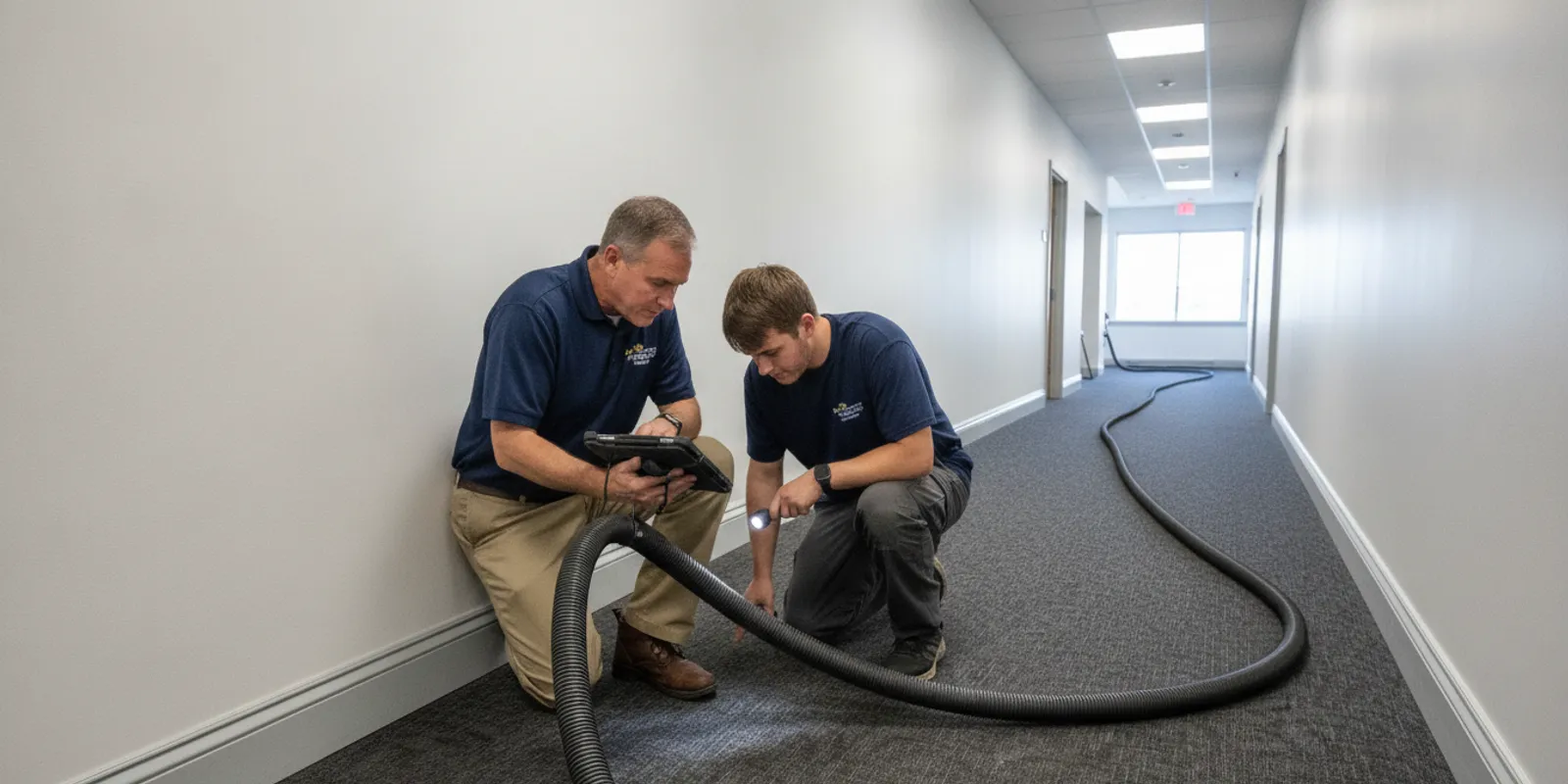
After water enters a workplace, a facility manager may wonder whether commercial cleaning can return affected rooms to service. The answer depends on what got wet, how long materials stayed damp, where the water came from, and whether mold is present. Cleaning can be part of recovery, but it does not replace stopping the leak, drying the building, or arranging qualified mold assessment and remediation when needed. This guide explains how to sequence those decisions, what to document, and how to request a scoped estimate without assuming every surface needs the same treatment.
Request a commercial cleaning estimate
What should happen first after water damage?
Start with the source and the safety of the space—not the carpet. If water is still coming in, contact the appropriate building professional to stop it. If the area may involve electrical hazards, structural damage, sewage, or another contaminated source, keep people away and contact qualified responders. Do not enter a space that may be unsafe simply to inspect a floor or move contents.
Once the source is controlled and the area can be approached safely, make a short record before cleanup changes the scene:
- Note when the water was first noticed and, if known, when the leak or overflow began.
- Record the suspected source, such as a supply line, roof intrusion, appliance, or drain. Mark uncertainty as uncertainty.
- Take overview photos and close photos of affected surfaces, furnishings, and visible water lines.
- List rooms and materials that appear wet, including carpet, pad, baseboards, drywall, furniture, and stored items.
- Write down what has already been done, such as shutting off a valve or moving contents, and keep related work orders.
This record helps the property manager, restoration professional, insurer, and cleaning provider discuss the same area. It is not a substitute for an inspection. Avoid discarding affected materials or starting a broad cleaning treatment until the right parties have reviewed the loss and any documentation requirements.
It can help to make a simple room-by-room log rather than relying on memory. Give each affected space a name that matches the floor plan, then note the visible boundary, materials, and current access status. For example, “east conference room, carpet wet near exterior wall, two chairs moved, no access pending assessment” is more useful than “office floor has water.” Keep observations separate from conclusions: “musty odor noticed at 3 p.m.” is an observation, while “mold behind the wall” is a diagnosis that needs qualified assessment.
When is water damage a mold concern?
Mold growth is associated with moisture, but a damp smell or a discolored spot alone does not establish what is growing, how far it extends, or which response is suitable. Water can travel under carpet, behind trim, or into wall cavities, where the visible wet area may not show the full extent. Persistent dampness, visible growth, recurring moisture, or a musty odor after drying deserves attention from a qualified professional.
Do not treat surface appearance as a reliable map of hidden conditions. A small-looking patch can sit above a larger damp area, while discoloration can have causes other than mold. Avoid brushing, sanding, or disturbing suspected growth to “see what is underneath.” That can spread dust and debris. If occupants have health concerns, follow their clinician’s advice and keep them out of areas that may be affected until the appropriate assessment is complete.
The U.S. Environmental Protection Agency provides general information about mold and moisture on its official website. For a particular building, use qualified local professionals to assess conditions and determine the appropriate scope; general guidance cannot diagnose a site or set a project plan.
Think about the timeline as well as the visible mark. A small spill that was promptly addressed is different from a slow leak that may have continued behind a cabinet for an unknown period. Record when the area was first found, whether the moisture returned, and what drying or repair steps have already taken place. If the source is uncertain, write that down rather than describing the water as clean or harmless. Those details help a qualified assessor decide what questions and inspections are appropriate.
How are commercial cleaning and mold remediation different?
These terms are sometimes used together after a leak, but they describe different scopes. Commercial cleaning addresses defined surfaces and routine or project cleaning needs. Mold assessment and remediation address suspected or confirmed growth and the conditions that support it. Water extraction and structural drying are also distinct work, aimed at removing water and bringing wet building materials toward an appropriate dry condition.
One contractor may offer more than one type of work, but a business should confirm each scope rather than assume. Ask who is responsible for identifying affected materials, controlling moisture, removing or treating impacted building components, and cleaning surfaces after that work. Get clarity on sequencing and handoffs in writing. A cleaning estimate should not be interpreted as a mold inspection, clearance, or guarantee that concealed materials are dry.
Cahill’s Carpet & Upholstery Cleaning offers commercial cleaning focused on carpet and related cleaning needs, and separately describes water-damage restoration services. The company should not be presented as a mold-remediation provider based on those services. A manager comparing options can review the stated commercial cleaning scope and separate water-damage restoration information, then ask which specific work fits the situation. If mold assessment or remediation is needed, confirm that a qualified provider is engaged for that role.
One practical way to keep scopes distinct is to write each job as a verb and an object. “Extract water from the carpeted room,” “assess damp wall materials,” “dry the affected construction,” and “clean the specified carpet after the area is ready” describe different actions. Ask each provider to confirm which of those actions it will perform and what conditions must be met before it starts. This small exercise can reveal a missing handoff before a crew arrives.
What should a facility manager ask before work begins?
A useful first conversation is specific, calm, and focused on the affected area. You do not need to diagnose the problem before requesting help. Instead, describe what you observed and ask how the provider’s work fits into the larger response.
- What exact surfaces are included? Separate carpet from pad, hard flooring, walls, furnishings, and contents. A proposal for carpet cleaning does not automatically include those other materials.
- What is the water source and condition? Share what is known, including whether water may have come from a drain or outside. If it is unknown, say so instead of labeling it clean.
- Has the leak been stopped and has drying been addressed? Ask whether the proposed visit is extraction, drying, cleaning after drying, or another defined task.
- Who evaluates possible mold? Confirm whether assessment and remediation are included, handled by another provider, or outside the estimate.
- How will the work affect access? Discuss occupied rooms, staff circulation, equipment, furniture, restricted areas, and the best time to perform the scoped work.
- What preparation is needed? Ask who moves contents, protects items, and documents the area. Do not assume heavy furniture will be moved or that all contents are safe to handle.
- What does completion mean? Request a plain description of what will be cleaned, what will remain, and whether any further assessment or drying is still outstanding.
For a commercial property, identify one point of contact who can approve access and decisions. Share a simple floor plan or mark affected rooms on a photo if that makes the scope easier to understand. If several vendors are involved, ask each to identify its handoff point. This can reduce conflicting assumptions, such as one provider expecting a room to be dry before another has checked it.
It is also useful to ask what information the provider needs before giving an estimate. A brief walk-through may be enough for a clearly bounded surface-cleaning task, while a water event involving concealed construction may require other professionals to assess conditions first. Ask whether the estimate can be prepared from the current information, whether a site review is needed, and what decisions remain outside the cleaning scope. This avoids treating a preliminary conversation as approval for work that has not yet been defined.
How does the affected material change the cleaning plan?
Material and construction matter. Carpet is not just its visible pile: the backing, pad, adhesive, and subfloor can respond differently to moisture. A professional should inspect the particular carpet and discuss whether the requested service is appropriate. A surface-cleaning plan cannot establish the condition of a concealed pad or floor below it.
Upholstered furniture, drapery, and area rugs also require material-specific consideration. Fibers, dyes, construction, backing, and prior treatments can affect what method is suitable. An item that was soaked by a leak may need assessment before routine cleaning is considered. Moveable contents should not be returned to a damp area just because the top surface feels dry.
For tile or other hard surfaces, water can still affect adjacent trim, wall cavities, joints, or materials below and beside the floor. Cleaning the visible surface alone may not address moisture in surrounding construction. Make the estimate request describe the precise surface and affected boundary rather than saying only “the floor.” Cahill’s also offers carpet cleaning as a separate service; an inspection and estimate can help establish whether that scope is suitable after water-related work is complete.
For example, suppose water reached only the carpeted portion of a reception area, while nearby tile and the corridor appear unaffected. The estimate request should identify the carpet boundary, note whether the carpet or underlying materials have been assessed, and ask whether the adjacent surfaces are excluded. A separate room with a wet area rug or upholstered seating should be listed independently. Describing each material helps the provider avoid assuming that one treatment fits all contents.
Do not ask a cleaner to promise complete stain, odor, or mold removal. Outcomes depend on the material, source, extent, timing, and prior treatment. The useful question is what the provider will inspect and do, what the work excludes, and what should happen if the assessment reveals a different condition.
How can a business plan for occupants and daily operations?
Cleaning and restoration can disrupt access even when the affected area is limited. Before setting a work window, identify entrances, shared corridors, customer-facing areas, staff schedules, deliveries, security procedures, and any rooms that must remain available. For an office, a phased plan may let teams use unaffected areas while a defined zone is addressed. For retail or other public-facing premises, consider how to direct visitors around a work area without suggesting that an uncleared area is ready for use.
Keep communication factual. Tell staff which spaces are restricted, who can authorize entry, and where updates will be posted. Do not report that a room is safe or fully restored unless the responsible professional has confirmed that status. If the building is leased, coordinate with the property owner or manager on access, approvals, and records before authorizing work that may affect building components.
There is no one schedule that fits every loss. The water source, affected materials, building conditions, and work sequence all affect timing. Ask for the next decision point instead of relying on a generic turnaround estimate: for example, when the initial assessment will be reviewed, who will confirm the area is ready for cleaning, and what information will be shared before the space returns to normal use.
A short operating plan can make a disruptive day easier to manage. Identify a route for employees and visitors that does not cross the work zone, decide where movable contents may be staged if approved, and tell staff whom to contact before entering a restricted room. If the affected area contains equipment or records, assign the proper internal person to decide how those items are handled; do not assume a cleaning crew can relocate or protect every item. After each phase, request an update describing what was completed and what still needs another party’s decision.
What should a commercial cleaning estimate request include?
A clear request helps a provider understand the job without promising a price or result before seeing the site. Include the facility location in the service area, the contact person, the kind of property, the affected rooms, the visible materials, and the size of the area if you can estimate it. Add when the damage occurred, the known water source, whether it has been stopped, and whether another contractor is already assessing or drying the building.
Also explain the operating constraints: hours when the space is accessible, security or check-in steps, furniture or equipment that cannot be moved, and whether the work needs to be coordinated with staff or tenants. Share photos if requested, but do not use photos to rule out hidden moisture or mold. A site visit may be needed to confirm the exact scope and estimate.
Before approving, read the estimate for what it includes and excludes. Check that it names the specific surfaces, work areas, and planned service rather than using a broad phrase such as “mold cleanup” without defining responsibilities. Ask whether the quote is for cleaning, water extraction, drying, or another service. If the situation requires a specialist assessment or additional work, ask who will coordinate that next step. Estimates depend on area, condition, soil or material, and treatment required; the scope should be clear before work proceeds.
A useful request can be organized into four parts: what happened, what is visibly affected, what other work is underway, and what you want the cleaner to assess. For instance: “A supply-line leak was stopped yesterday in the south office. Carpet is visibly wet near two desks; the pad and wall have not been assessed. A restoration provider is scheduled to evaluate drying. Please advise whether a carpet-cleaning estimate is appropriate after that assessment, and what preparation or access is needed.” This wording reports the known facts and asks for a next step without calling the water safe or presuming the correct treatment.
If the building also needs routine carpet care, keep that request separate from the water-loss response. Note the rooms used most heavily, any access or security requirements, and whether the work is intended as a one-time project or part of a recurring maintenance discussion. The provider can then assess the ordinary cleaning need without confusing it with wet-material drying or mold-related work. If an affected area is still under review, ask whether to wait until the responsible restoration professional confirms the next step. Separating the requests makes it easier to compare the proposed work with the building’s actual priorities.
Ask Cahill’s about a scoped commercial cleaning estimate
How can you coordinate separate providers?
When more than one provider is involved, establish who owns each part of the work before the schedule fills up. One person may handle the leak, another may assess building materials and drying, and a cleaning provider may address carpet or other surfaces afterward. Ask each provider to identify the boundaries of its assignment. A simple list with the company, contact person, area, task, and expected handoff can help the property team keep responsibilities clear.
Share relevant findings with permission and keep a dated record of reports, photos, moisture checks if performed by the responsible professional, and decisions about access. If an assessment changes the known scope—for example, wetness is found outside the room first reported—pause and ask who needs to review the change before proceeding. Do not ask a cleaning crew to make a technical determination that belongs to a restoration or mold professional. Likewise, do not assume a later surface-cleaning visit has verified concealed construction or provided mold clearance.
Agree on how updates will reach the people who use the building. Name one person to collect questions, tell employees or tenants which areas are temporarily unavailable, and explain when the next update is expected. If the space has a landlord, insurer, or facilities contractor with approval requirements, check those requirements early. Keep statements about the condition measured: distinguish what has been observed, what a professional has assessed, what work is complete, and what remains unconfirmed. Clear handoffs make it easier to request the right service without overstating what any single provider has done.
A handoff note can be brief but should answer practical questions: what area is ready for the next trade, what is still restricted, what items remain in place, and whom to contact if new moisture or visible changes appear. If a provider recommends an additional evaluation, record who will arrange it and whether the current schedule should pause. Do not treat silence or a completed surface-cleaning appointment as confirmation that every other part of the building response is finished.
How should you decide what to do next?
Separate the response into decisions: stop the water source, make the space safe, document what is affected, assess and dry wet building materials, address suspected mold with a qualified provider when appropriate, and arrange surface cleaning only when the scope and timing make sense. Some steps may overlap under a coordinated plan, but do not assume that one service covers all of them.
For local property and facility managers in Huntingdon Valley, Southampton, Jenkintown, Abington, Willow Grove, Langhorne, Newtown, and Montgomery and Bucks Counties, the best estimate conversation begins with the affected rooms and materials, not a broad promise. Cahill’s can discuss commercial carpet cleaning or its stated water-damage restoration scope and help clarify whether the requested cleaning work fits. When a concern falls outside that scope, ask which qualified professional should handle it before authorizing the next step.
Frequently asked questions
Can commercial cleaning remove mold after a leak?
Do not assume a routine commercial cleaning visit is mold assessment or remediation. First confirm who will assess suspected growth and address moisture conditions. A cleaning provider can explain its defined surface-cleaning work, but the proposal should not be treated as a diagnosis or clearance.
Should carpet be cleaned before the building is dry?
Not as a general rule. The appropriate sequence depends on the materials, water source, and findings from the professionals assessing the loss. Ask who is responsible for drying and when the carpet-cleaning scope is appropriate; a dry-feeling surface does not confirm the condition of hidden materials.
What if the water source is unknown?
Say that it is unknown and share any observations about where the water appeared or whether it may have involved a drain or exterior intrusion. Do not label it clean based on appearance. A qualified responder can help determine what precautions and next assessments are appropriate.
Does a cleaning estimate include every affected material?
No. Ask for the estimate to name the exact rooms, surfaces, and tasks included, as well as exclusions and preparation requirements. Carpet, pad, walls, upholstery, hard flooring, and contents should not be assumed to share one scope.
Water damage calls for a coordinated response, not a single broad promise. Document what is known, keep unsafe or unassessed spaces restricted, clarify who is responsible for moisture and mold questions, and request cleaning only for a defined surface and suitable stage of the work.