
You notice it first when you walk in from outside on a humid July afternoon. The house is cool, the AC is running — and there’s that smell. Musty, slightly stale, somewhere between damp and earthy. You vacuum. You open windows. You light a candle. It fades for a few hours, then it’s back.
Musty carpet odor in summer is one of the most common complaints we hear from homeowners throughout Philadelphia, Bucks County, and Montgomery County — and in our 45+ years of professional carpet cleaning, it’s also one of the most misunderstood. Most homeowners assume it’s a cleaning problem. It’s actually a moisture problem, and the carpet is usually a symptom, not the source.
Understanding what’s actually causing that smell — and why masking it doesn’t fix it — is the difference between spending all summer managing an odor and actually eliminating it. Here’s what you need to know.
What You’ll Learn
- Why Philadelphia-area summers create the conditions for musty carpet odor
- What is actually producing the smell — and why it returns after you’ve cleaned
- How to identify whether your carpet, padding, or subfloor is the source
- DIY steps that help and the limits of what they can fix
- What professional carpet cleaning addresses that home treatments cannot
- Frequently asked questions from Bucks County and Montgomery County homeowners
The Problem: What Musty Summer Carpet Smell Actually Is
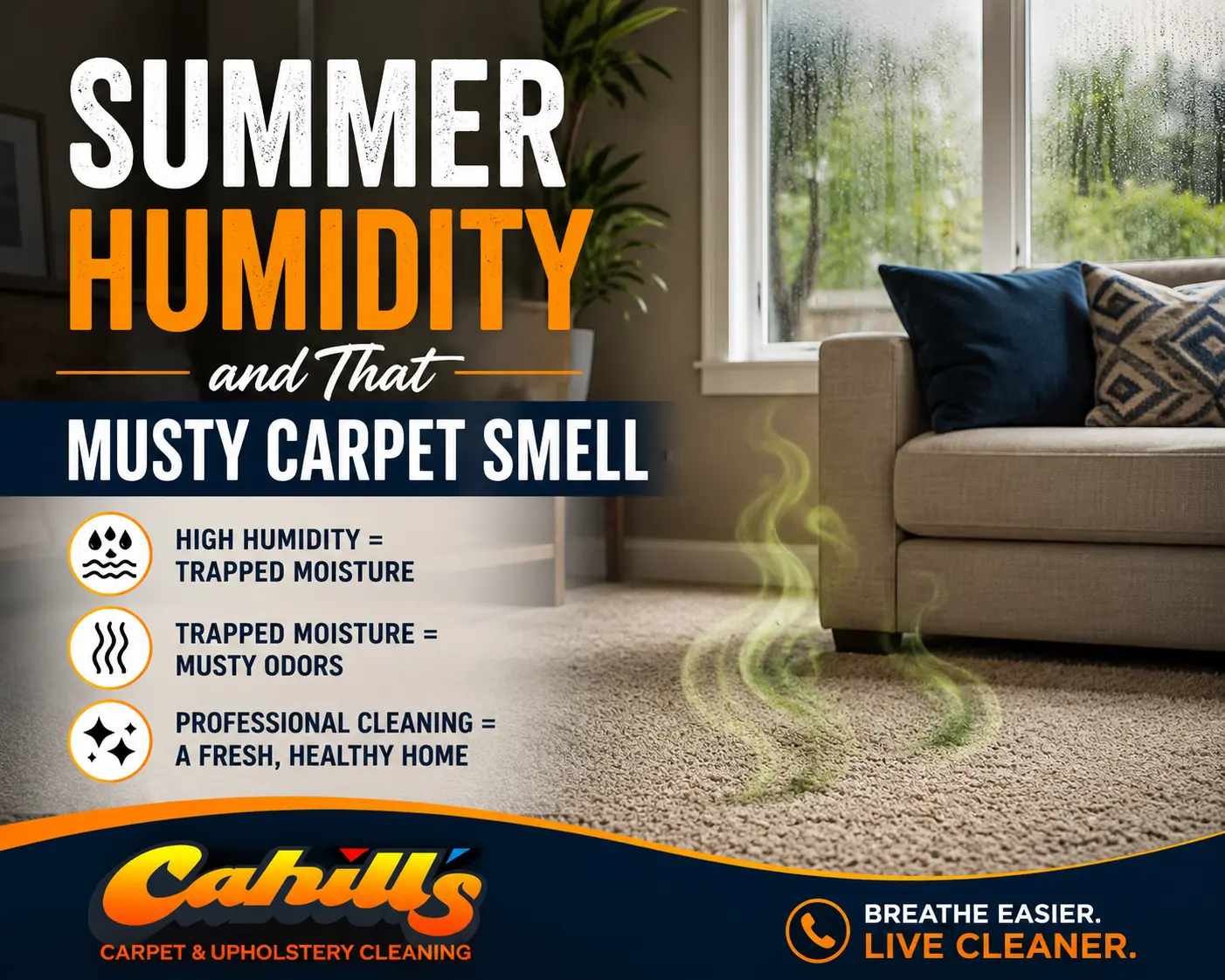
That musty odor is not just stale air, and it’s not something a fabric spray will resolve. It’s a biological signal: microbial volatile organic compounds (MVOCs) produced by mold, mildew, and bacteria actively growing in your carpet system. You’re not smelling dirt. You’re smelling the metabolic byproducts of living organisms feeding on organic material in your carpet fibers, padding, or backing.
This is why it comes back. Air fresheners, candles, and baking soda absorb or mask the odor temporarily — but the source organisms keep producing it. Until the biological activity is addressed and the moisture conditions enabling it are corrected, the smell returns.
Warning signs that point specifically to humidity-driven musty carpet odor:
- The odor is strongest in summer months and weaker or absent in dry winter conditions
- The smell intensifies after rain or on high-humidity days, even when the AC is running
- The odor is more noticeable in basements, lower floors, or rooms with less air circulation
- Walking across the carpet seems to release or intensify the smell
- The carpet feels slightly damp to the touch in affected areas, even without any known spills
- Anyone in the household with allergies or asthma notices symptoms are worse at home during summer
If two or more of these match your situation, humidity-driven microbial growth is almost certainly the cause — and the solution requires more than vacuuming or deodorizing.
Why Summer Humidity Causes Musty Carpet Smell: The Real Causes
The Philadelphia area is genuinely humid in summer. Average relative humidity in July and August regularly exceeds 70–80%, and the combination of warm outdoor air, air conditioning, and the organic material naturally present in any household carpet creates near-ideal conditions for microbial growth.
If you’re wondering what does carpet mold smell like, it’s often described as musty, earthy, damp, or similar to the smell of a wet basement. When that odor becomes noticeable during humid summer weather, excess moisture may be getting trapped in the carpet fibers, padding, or even the subfloor beneath it.
Here’s the specific chain of causes.
1. Humidity Reactivates Dormant Contamination in Carpet Backing and Padding
Every carpet accumulates organic material over time: skin cells, pet dander, food particles, tracked-in soil, and moisture from spills, wet shoes, and humidity itself. Even if your carpet appears clean, this organic reservoir exists at the fiber base and in the padding beneath. It’s largely inert in dry conditions — but when relative humidity rises above roughly 60%, moisture in the air is sufficient to reactivate dormant bacteria and mold spores already present in the carpet system.
This is why the odor seems to appear with the summer weather rather than following any specific incident. Nothing new happened to the carpet. The existing organic load simply became an active food source as humidity climbed.
Carpet padding is particularly vulnerable. Most residential padding is foam or fiber material that holds moisture significantly longer than carpet fibers — and it sits directly against the subfloor, where temperature differentials can create condensation. Padding that absorbed moisture from a past spill, humid season, or improper cleaning that wasn’t fully extracted can harbor active microbial growth for months or years.
2. Air Conditioning Creates Condensation Conditions Near the Floor
This surprises many Bucks County and Montgomery County homeowners: running the air conditioner can actually contribute to musty carpet odor rather than preventing it. Here’s why.
When warm, humid outdoor air enters a cooled home — through doors, windows, and normal air infiltration — it contacts cooler surfaces near the floor. The floor level is typically cooler than the rest of the room when AC is running. As warm, moisture-laden air cools near the floor, it releases moisture onto carpet fibers and padding. This is the same principle behind condensation forming on a cold glass on a humid day, applied to your floor.
In homes with basements or slab foundations — common throughout Doylestown, Warminster, Jenkintown, and the wider Philadelphia area — ground moisture adds another moisture source below the carpet system, particularly in summer when soil moisture is high.
3. Past Spills or Cleaning Moisture That Was Never Fully Extracted
One of the most common causes of persistent summer musty odor is a spill or cleaning event from months or even years earlier that left residual moisture in the padding. In dry months, the area dried sufficiently that no odor was noticeable. When summer humidity elevated the overall moisture level in the carpet system, that previously dried padding re-moistened enough to reactivate the mold or bacteria that colonized it during the original wet event.
DIY carpet cleaning machines and consumer rental equipment extract far less moisture than professional truck-mounted systems. Over-wetting during DIY cleaning — particularly on thicker carpet with dense padding — is one of the most common paths to recurring musty odor problems we encounter throughout our service area.
4. Insufficient Air Circulation in Low-Traffic Areas
Carpet in areas with limited air movement — under furniture, in rarely used guest rooms, in finished basements with minimal HVAC flow — dries more slowly than carpet in well-circulated spaces. In humid summer conditions, these areas can maintain enough ambient moisture to support ongoing microbial activity even when the rest of the home feels comfortable. The odor often seems to “come from nowhere” because the affected area isn’t somewhere the homeowner interacts with daily.
How to Identify Where the Musty Smell Is Coming From
Before treating musty carpet odor, it’s important to identify whether the source is the carpet fibers, the padding beneath, or a more serious subfloor or structural moisture issue. Here’s a practical assessment process:
- Localize the smell: walk the room slowly and note where the odor is strongest. Concentrated odor in a specific zone often points to a past spill or a moisture intrusion point; diffuse odor throughout the room suggests general humidity-driven accumulation.
- Check the carpet surface temperature: on a humid day, press your palm flat against different areas of the carpet. Areas that feel noticeably cooler or slightly damp are moisture accumulation zones.
- Lift a corner of the carpet in the affected area if accessible. Smell the padding directly. If the odor is significantly stronger from the padding than from the carpet face, the contamination source is in the padding or below — and carpet cleaning alone will not fully resolve it.
- Check for visible mold on the back of any carpet you lift. Mold appears as gray, black, or greenish discoloration on the carpet backing or the padding surface. Visible mold growth indicates a more advanced problem that requires professional assessment.
- Note the pattern: if the odor is concentrated in a basement or lower level, ground moisture infiltration may be contributing. If it’s on an upper floor, the cause is more likely humidity reactivation of existing organic contamination or a past spill.
If the odor source appears to be in the padding or subfloor, or if you find visible mold, contact Cahill’s at (215) 355-5388 before attempting DIY treatment. Mold remediation in carpet systems can require a different approach than standard cleaning, and improper handling can spread spores.
Solution Options for Philadelphia-Area Homeowners
What You Can Do at Home
For mild humidity-driven odor where the source appears to be in the carpet fibers rather than the padding, these steps can provide meaningful improvement:
- Reduce indoor humidity: run a dehumidifier to bring relative humidity below 50% in affected areas. This alone will reduce the active microbial growth rate significantly. A whole-home dehumidifier connected to your HVAC is the most effective solution; a portable unit is a good interim measure.
- Increase air circulation: run ceiling fans on low in affected rooms, ensure HVAC vents are unobstructed, and consider running a fan across the carpet surface in problem areas during dry weather to promote evaporation.
- Vacuum thoroughly before any treatment: vacuum slowly in cross-directional passes to lift pile and remove as much surface organic material as possible before applying any moisture-based treatment.
- Apply baking soda to affected areas and leave for several hours before vacuuming: baking soda is a mild odor absorber that can reduce surface odor temporarily. It does not address the biological source but can reduce intensity while you arrange professional cleaning.
- For mild cases, a diluted white vinegar solution (1:1 with water) misted lightly on affected areas and allowed to dry fully can temporarily inhibit surface microbial activity. Mist lightly — do not saturate.
Be clear-eyed about what these steps accomplish: they manage surface symptoms. If the contamination source is in the padding or backing — which is common when the odor has persisted across more than one summer season — home treatments will not fully resolve it.
What Professional Carpet Cleaning Resolves
Professional hot water extraction by Cahill’s IICRC-certified technicians addresses musty carpet odor at a level home treatment cannot reach. Here’s what the process does:
- Removes the organic load from the carpet fibers and backing that microbial organisms are feeding on — eliminating the food source rather than just treating the symptom
- Flushes the carpet backing with hot water under pressure, reaching contamination that surface vacuuming and DIY spot treatment leave behind
- Extracts approximately 95% of the introduced moisture immediately using truck-mounted vacuum power unavailable in consumer equipment — preventing the over-wetting that makes musty odor problems worse
- Applies enzymatic treatment to affected areas where biological contamination is concentrated — enzymatic agents break down the organic compounds at the molecular level, not just masking the odor
- Allows full assessment of whether the odor source extends into padding or subfloor, with honest guidance on whether padding replacement is warranted
The critical distinction between professional and DIY cleaning in the context of musty odor is moisture management. The primary risk of DIY wet cleaning for a carpet with existing microbial activity is introducing more moisture than can be extracted — which accelerates the growth rather than addressing it. Professional equipment extracts moisture as it cleans, preventing this cycle.
Addressing the Underlying Humidity Problem
Professional cleaning resolves the existing contamination, but if the humidity conditions that caused it remain unchanged, the odor can recur the following summer. A few structural steps that significantly reduce recurrence:
- Maintain indoor relative humidity at 45–55% year-round using a whole-home or portable dehumidifier
- Ensure HVAC filters are changed regularly to maintain airflow efficiency
- Check basement and crawl space moisture barriers; ground moisture infiltration is a significant driver of lower-level carpet odor throughout the Philadelphia area
- For rooms over unconditioned spaces or with slab foundations, consider area rugs with moisture-resistant backing rather than wall-to-wall carpet
Why Philadelphia-Area Homeowners Choose Cahill’s for Odor Problems
Musty odor problems are among the most frustrating carpet issues homeowners face because they’re invisible, they return despite effort, and the cause isn’t always obvious. In 45+ years serving families throughout Philadelphia, Bucks County, and Montgomery County, Cahill’s has diagnosed and resolved thousands of odor situations — from mild seasonal humidity cases to severe mold and pet contamination scenarios.
What makes Cahill’s the right call for odor problems specifically:
- IICRC-certified technicians with an average of 11 years experience — trained to identify whether odor is fiber-level, padding-level, or subfloor-level before recommending treatment
- Truck-mounted hot water extraction providing the moisture removal capacity to clean thoroughly without the over-wetting risk that worsens microbial activity
- Enzymatic treatment application for biological contamination — addressing the molecular source of the odor rather than masking it
- Honest assessment: we tell customers when padding replacement is the right answer, not just the more profitable one
- 45+ years serving Bucks County, Montgomery County, and Philadelphia families — 2023 Community’s Choice Award Winner
- Nextdoor Neighborhood Favorite, multiple years recognized
- 5-star ratings on Google, Yelp, Angi, and Nextdoor
- BBB A+ rated and accredited since 2011
- 24/7 answering service — available for urgent situations any time
Frequently Asked Questions
Why does my carpet smell musty only in summer?
The seasonal pattern is the key diagnostic signal: musty odor that appears or intensifies in summer is almost always driven by humidity. When relative humidity rises above 60–65%, existing organic material in carpet fibers and padding — which was dormant in dry conditions — becomes an active food source for mold and bacteria. The organisms produce MVOCs (microbial volatile organic compounds) that you smell. The carpet isn’t getting dirty differently in summer; the existing contamination is becoming biologically active.
Can I fix musty carpet smell myself?
For mild surface-level odor, reducing indoor humidity, increasing air circulation, and applying baking soda can provide temporary improvement. However, if the contamination source is in the carpet backing or padding — which is common in cases that have persisted more than one season — DIY methods won’t fully resolve it. Worse, DIY wet cleaning without professional extraction can introduce additional moisture that accelerates microbial growth rather than stopping it.
How do I know if the smell is from the carpet or the padding?
Lift a corner of the carpet in the area where odor is strongest and smell the padding directly. If the odor is significantly stronger from the padding than from the carpet face, the source is below the carpet surface. In this case, cleaning the carpet alone will not fully eliminate the odor — professional cleaning that reaches the backing combined with an evaluation of the padding condition is needed.
Is musty carpet smell a health concern?
Musty odor from mold and mildew activity in carpet can be a concern for household members with allergies, asthma, or other respiratory sensitivities. The MVOCs that produce the odor, and the mold spores that may be present in an actively growing colony, are known respiratory irritants. If anyone in your home experiences worsening allergy or asthma symptoms specifically at home during summer, carpet contamination is worth evaluating as a possible contributing factor.
Does professional carpet cleaning make musty smell worse temporarily?
A temporary intensification of odor during or immediately after professional cleaning is normal and not a sign that cleaning made things worse. As hot water reaches contaminated areas, it disturbs the microbial material and the odor is briefly more pronounced. This dissipates within hours as the carpet dries and the contamination that was producing the odor has been removed. If the odor is still strong 24–48 hours after professional cleaning, contact Cahill’s — there may be residual contamination in the padding that needs further treatment.
How long does carpet take to dry after professional cleaning in summer?
With Cahill’s truck-mounted extraction equipment, professionally cleaned carpet typically dries in 6–12 hours under normal conditions. In summer, running the air conditioner and ceiling fans speeds drying by reducing ambient humidity and increasing air circulation. Avoid walking on carpet with bare feet or damp shoes during the drying period, and keep pets off cleaned areas until fully dry.
How much does professional carpet cleaning cost in Bucks County?
Cost depends on square footage, number of rooms, carpet condition, and whether additional treatments such as enzymatic odor treatment are needed. Cahill’s provides free estimates for most jobs over the phone at (215) 355-5388 — no obligation. For musty odor situations, we’ll ask a few questions to understand the scope before giving you an accurate estimate.
Do you serve Bucks County and Montgomery County for carpet odor cleaning?
Yes. Cahill’s 6-truck fleet serves all of Bucks County — including Doylestown, Warminster, Newtown, Richboro, Southampton, Langhorne, Yardley, and Holland — and all of Montgomery County, including Jenkintown, Abington, Willow Grove, Glenside, Horsham, Ambler, Fort Washington, and Hatboro, plus all Philadelphia neighborhoods. Call (215) 355-5388 to confirm service to your area.
Next Steps: Get Rid of the Musty Smell for Good
If you’re dealing with musty carpet odor this summer, don’t spend another season managing it. Here’s how to move forward:
- Do the quick assessment: check whether the odor is localized or throughout the room, and lift a carpet corner to smell the padding directly
- Start the dehumidifier: bring indoor humidity below 50% immediately to slow active microbial growth while you arrange professional cleaning
- Call Cahill’s at (215) 355-5388 for a free estimate — describe where and when the smell is strongest and we’ll advise on the right approach
- Ask about enzymatic treatment if the odor has persisted across more than one season — it’s the difference between treating the symptom and eliminating the source
- Our 24/7 answering service means you can reach us any time, including evenings and weekends
Cahill’s Carpet & Upholstery Cleaning | (215) 355-5388 | cahillscarpetcleaning.com
Serving Philadelphia, Bucks County, and Montgomery County since 1980. Trusted Since 1980 — Family-Owned Excellence.
About the Author
Bill Cahill founded Cahill’s Carpet & Upholstery Cleaning in 1980 with a single truck and a commitment to professional service. Over 45+ years later, he leads a team of IICRC-certified technicians — averaging 11 years experience each — serving Philadelphia, Bucks County, and Montgomery County. Cahill’s was recognized as the 2023 Community’s Choice Award Winner and maintains 5-star ratings across Google, Yelp, Angi, and Nextdoor.